Blog

  • CentoViva Project – Living Longer, Stronger

    This is post 1 of 1 in the series “Fasting Mimicking Diet”

    I’ve always been a tech person at heart, not a doctor. But when it comes to my health, I carry a deep sense of curiosity. With a family history full of cardiovascular disease, diabetes, and other chronic conditions, I’ve always felt the need to be watchful. I don’t just want to add years to my life, I want those years to be full of strength, movement, and clarity.

    Like most of us today, I don’t get enough sunlight. I know exercise and movement are the foundation of staying young, but I also began to wonder: what else can I do to give my body the best chance at repairing itself, thriving, and deferring the effects of aging?

    That curiosity has sparked endless questions:

    • What’s the right level of Vitamin B12, and why does it matter for energy and brain health?
    • How much Vitamin D3 do I really need, and what does the science say about its role in immunity, mood, and longevity?
    • Which supplements are truly backed by research, and which ones are just hype?
    • How do I know if a supplement is safe to take, even if it doesn’t help, can I be sure it won’t do me harm?
    • And beyond supplements: how can I improve sleep, support cellular repair, and align my lifestyle with the latest science?

    I realized that what I was really searching for was clarity. Not vague advice. Not marketing promises. But structured, science-backed answers I could trust, explained simply, and applied safely to everyday life.

    That’s what the CentaViva Project is about.
    It’s a living guide to the big questions we all have about health: why a certain nutrient matters, how it works in the body, how much is optimal, and what the research really says about safety and effectiveness. It’s not about chasing miracles. It’s about building confidence, knowing that every choice you make is informed, supported by science, and aligned with your goal of living not just longer, but stronger.

  • Why most BD deals breakdown eventually

    Business development deals often stumble because they lack a basic principle: give and take. When one party gives far more than it receives in return, the imbalance eventually erodes trust and enthusiasm. This mismatch, industry experts say, is one of the leading causes of partnership failures.

    The root of the problem lies in uneven value exchange. Deals break down when one side shoulders more of the risk, effort, or resources without seeing proportional rewards. Partnerships based on transaction rather than collaboration foster resentment instead of lasting commitment.

    Experts emphasize the importance of defining mutual value early in negotiations. Successful partnerships require clear agreements on what each party brings to the table—be it access to customers, knowledge, or strategic resources—and what they expect in return. Shared goals and success metrics are also critical, ensuring both sides win and continue to invest in the relationship.

    Reciprocity goes beyond contracts, advocates say. It means actively supporting your partner’s growth, recognizing that their success expands opportunities for all involved. Regular check-ins to assess whether both sides are benefiting help prevent imbalances from festering.

    At the heart of thriving business development is open communication and trust. Transparency about challenges and a willingness to adapt can turn potential points of friction into opportunities for joint problem-solving.

    Ultimately, the most enduring deals are not those that extract value once, but those that build ongoing, balanced exchange and in doing so, create a foundation for mutual growth.

  • MSTR analysis


    Key risks of buying MSTR

    1. Bitcoin price volatility
      • Since a large part of MSTR’s value comes from its bitcoin holdings, big swings in BTC price directly affect MSTR’s stock. If Bitcoin drops a lot, MSTR tends to drop more. (coininsight360.com)
      • Losses can be magnified because (a) MSTR uses debt and capital markets to fund BTC purchases, (b) there are accounting impairments when BTC’s fair value falls below carrying value. (Cryptodamus)
    2. High leverage and debt exposure
      • MSTR has taken on debt and convertible notes (debt that can convert into equity). If the price of stock or bitcoin falls, servicing debt becomes harder. (coininsight360.com)
      • Rising interest rates increase the cost of borrowing. If MSTR’s debt is floating or issues new debt in a high-rate environment, that raises risk. (Monexa AI)
    3. Dilution
      • To raise funds for buying more Bitcoin, MSTR has issued more shares and also preferred stock. More shares means each share holds a smaller piece of the pie. That can erode value for existing shareholders. (The Ridgway Record)
      • Convertible debts also could convert into shares, adding to dilution. (Investing.com)
    4. Premium collapse
      • The stock often trades at a premium compared to the NAV (net asset value) of its BTC holdings. If investor sentiment shifts or BTC declines, that premium can fall sharply, meaning MSTR could lose value even if BTC is steady. (BitcoinEthereumNews.com)
      • There’s risk that while BTC may go up, the stock doesn’t keep up or declines because the premium compresses. (Investing.com)
    5. Regulatory / tax / accounting risk
      • Laws or regulations around cryptocurrency could change. Tax treatment of gains or the way companies account for assets like Bitcoin might shift, increasing cost or risk. (Cryptodamus)
      • For example, under current accounting rules, when BTC value falls, impairment losses are recognized (even without a sale). This can hurt earnings reports and investor sentiment. (Cryptodamus)
      • There are recent/tending changes: e.g. ASU 2023-08 for reporting digital assets’ fair value, and potential exposure under the corporate alternative minimum tax (CAMT). (Investopedia)
    6. Liquidity risk / being forced to sell
      • If BTC collapses or if debt or preferred stock obligations are large, MSTR might need to sell BTC or raise capital at bad times, possibly locking in losses. (Cryptodamus)
      • If lenders demand repayment or in convertible debt scenarios, there might be pressure. (coininsight360.com)
    7. Operational / business risk outside Bitcoin
      • MSTR isn’t just a Bitcoin holding company; it has a software business. If that business underperforms (due to competition, product issues, or market conditions), it adds drag. (StockStory)
      • Reputation, cybersecurity, legal risks are also elevated given the size of its BTC holdings and visibility. E.g. risk of theft, regulatory scrutiny. (The Ridgway Record)
    8. Competition from alternatives
      • There are now “simpler” or more direct ways to get exposure to Bitcoin (ETFs, trusts). These alternatives might have lower costs, less complexity and less risk of dilution or accounting complications. Investors might prefer them, reducing demand for MSTR. (The Ridgway Record)
    9. Index / market structure risks
      • Because MSTR is included in various indices, its market-cap and the behavior of passive funds can amplify movements. If indices change rules or exclude MSTR, or if fund flows reverse, that could lead to rapid outflows. (Investing.com)

    Summary: Which risks are biggest

    • The biggest risk is probably Bitcoin going down — since much of MSTR’s value is really a leveraged bet on Bitcoin.
    • Leverage / debt magnify that risk.
    • Dilution (from share or preferred issuance) can quietly erode returns even if things look good at first.
    • Regulatory / tax changes could increase costs or reduce profitability in ways that are harder to predict.

    mNAV was 2.7 in May and its 1.42 now? Why is that?

    MicroStrategy’s mNAV (market-to-NAV multiple) was ~2.7 in May and is now ~1.42, meaning the premium that MSTR stock trades at relative to the value of its Bitcoin per share has fallen sharply.


    Here’s what drives the change:

    1. Definition of mNAV

    • NAV/share ≈ (BTC holdings × BTC price) ÷ shares outstanding.
    • mNAV = (MSTR share price ÷ NAV/share).
      So mNAV > 1 means MSTR trades at a premium to the value of its Bitcoin per share.

    2. Why mNAV falls

    A decline from 2.7 → 1.42 means investors are paying a much smaller premium now for each dollar of Bitcoin exposure via MSTR. The main reasons:

    1. ETF competition (structural factor)
      • In January 2024, U.S. spot Bitcoin ETFs launched. They let investors buy Bitcoin exposure directly, cheaply, and transparently.
      • Before ETFs, many investors used MSTR stock as a proxy for Bitcoin (especially institutions that couldn’t hold BTC directly). That demand inflated the mNAV multiple.
      • With ETFs available, demand for MSTR as a proxy declined, compressing its premium.
    2. Dilution from new equity issuance
      • MicroStrategy regularly issues new shares (ATM offerings, preferred stock) to raise capital to buy more Bitcoin.
      • More shares outstanding means NAV/share doesn’t rise as much as total holdings.
      • Investors may also price in dilution risk, lowering willingness to pay a big premium.
    3. Sentiment shift / less speculative enthusiasm
      • In periods of bullish hype, people are willing to pay large premiums for leverage via MSTR (since it acts like “Bitcoin on steroids” because of debt).
      • When sentiment normalizes or risk appetite drops, that premium collapses.
      • May 2024 coincided with strong momentum in Bitcoin expectations post-ETF approval → higher speculative premium. By now, sentiment is cooler.
    4. Market recognition of alternatives
      • Besides ETFs, investors realized they can simply buy BTC itself or funds with lower management cost and no corporate execution risk.
      • MSTR has software operations, debt service, dilution, and tax/accounting quirks. These risks weigh on valuation vs. pure BTC exposure.
    5. Index / market technicals
      • MSTR inclusion in indices can inflate price temporarily. If weighting changes or flows slow, demand eases.
      • That also pulls mNAV lower.

    3. Interpreting the drop

    • At 2.7 mNAV: You were paying $2.70 for each $1 of BTC that MSTR actually held per share.
    • At 1.42 mNAV: Now you pay $1.42 for each $1 of BTC held.
    • The drop means either:
      • MSTR stock rose less than BTC, or
      • BTC rose while MSTR stayed flat, or
      • MSTR issued shares that increased NAV/share but share price didn’t rise proportionally.
        In practice it’s a combination of these, mostly due to ETF competition and dilution.

    What about buying bitcoin ETFs vs MSTR, is or isn’t MSTR better leverage?

    Yes, this is a key consideration: MSTR vs a Bitcoin ETF is not just a straight BTC comparison, it’s really about leverage, risk, and structural differences. Let’s break it down clearly.


    1. MicroStrategy (MSTR) as leveraged BTC exposure

    Mechanics:

    • MSTR buys Bitcoin using both cash and debt, then holds it on its balance sheet.
    • Shareholders get exposure to Bitcoin plus any leverage effect, because debt amplifies gains and losses.
    • Example (simplified):
      • Company has $1B cash + $1B debt, buys $2B BTC.
      • If BTC rises 10%, NAV rises 10% on $2B holdings. But debt is fixed, so equity holders’ gain is magnified.

    Pros:

    • Leveraged upside without personally taking on margin risk.
    • Institutional infrastructure already in place (you don’t need to manage storage/security).
    • Could outperform BTC in a bull market because of leverage and premium multiple (mNAV > 1 at times).

    Cons / Risks:

    1. Leverage downside – losses are amplified if BTC drops.
    2. Dilution risk – new shares issuance to buy BTC lowers NAV/share.
    3. Debt / interest risk – company must service debt even if BTC falls.
    4. Premium risk (mNAV compression) – you may overpay relative to NAV.
    5. Corporate / operational risk – SEC filings, accounting, legal issues.

    2. Bitcoin ETFs

    Mechanics:

    • ETFs (like BITO, BTF) track BTC price, sometimes with futures contracts (for BITO) or spot BTC (for spot ETFs).
    • Price moves almost 1:1 with BTC, minus fees.
    • No company leverage is applied; you get pure BTC exposure.

    Pros:

    • Cleaner exposure to BTC price.
    • Lower fees than indirect corporate vehicle.
    • No dilution or operational risk.
    • No corporate debt or mNAV risk.

    Cons / Risks:

    • No leverage, so upside is “pure BTC,” not magnified.
    • Futures-based ETFs can have tracking error (for BITO).
    • Taxes may differ (depending on ETF structure).

    3. Comparing upside / leverage

    • MSTR is leveraged BTC, in the sense that gains/losses per share can exceed BTC’s % change.
    • But that leverage comes with extra risk (debt, dilution, corporate operations).
    • ETFs give you clean 1:1 exposure, but no magnified upside.

    Illustration (rough numbers):

    ScenarioBTC +10%BTC -10%
    BTC ETF+10%-10%
    MSTR (leveraged, mNAV > 1)+15–25%-15–25%

    The actual leverage depends on debt, premium, and share issuance timing. In practice, MSTR’s volatility is much higher than BTC, both up and down.


    4. Key consideration

    • If you want pure BTC exposure with less complexity, ETFs are better.
    • If you want leveraged upside and can handle volatility, MSTR can outperform in a bull market.
    • You must be ready for larger swings, dilution, and mNAV collapse, which can happen even if BTC goes up modestly.

  • MSTR – quite an interesting play

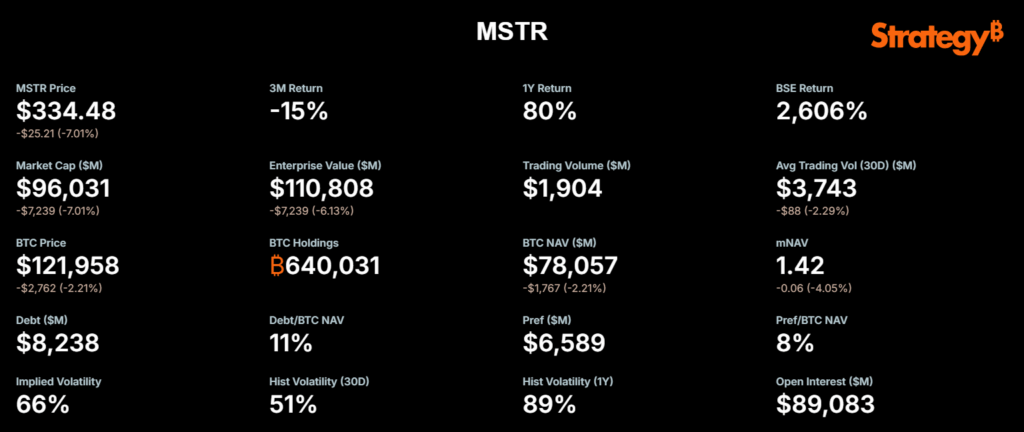
    I don’t quite understand bitcoin, but this company seems to be making some real smart moves here. They’ve got 640K Bitcoin and they are leveraging those holdings to buy more. 11% Debt/BTC NAV is not big leverage, but it gives them big moves.

    The whole thing can come crashing down if BTC goes poof. But if it doesnt, this can be quite interesting.

    Few interesting things to look at further —

    + https://strategytracker.com/
    + https://tokeninsight.com/en/research/analysts-pick/microstrategy-s-nav-premium-and-btc-yield … mNAV was 2.7 in May, its 1.42 today; mNAV could be falling because they are issuing more shares and as a result the BTC holdings/share are fewer.
    + https://my.tradingview.com/script/f1az22Lx-MSTR-mNAV-Indicator/?utm_source=chatgpt.com
    +https://www.strategy.com/purchases

    + https://stockcharts.com/sc3/ui/?s=MSTR&p=W&yr=5&mn=0&dy=0&id=p18240702326

    + https://stockcharts.com/h-sc/ui?s=%24BTCUSD&p=W&yr=%2&mn=%3&dy=0&id=p66175140057


  • The right time for supplements & multi-vitamins

    SupplementBest time to takeNotes
    Vitamin B12MorningCan give an energy boost; best with or after a meal.
    Vitamin D3Morning/AfternoonTake with a meal containing fat for better absorption.
    Vitamin CMorningWater-soluble; can be taken on empty stomach but may cause stomach upset for some.
    MultivitaminMorningWith food to aid absorption and reduce nausea.
    Fish Oil (Omega-3)With mealsBest absorbed with fat-containing meals.
    MagnesiumEveningMay promote relaxation and better sleep; avoid taking with calcium.
    CalciumWith mealsTake in smaller doses (≤500 mg) for better absorption; avoid with iron.
    IronEmpty stomachBest absorbed without food; avoid taking with calcium or caffeine.
    ProbioticsMorning/Empty stomachTake 30 min before food for best survival through stomach acid.
    ZincWith foodPrevents nausea; avoid taking with calcium or iron for absorption reasons.
  • The patient journey, end to end

    This is post 7 of 7 in the series “US Healthcare in Plain English”

    1. The cast of US healthcare, in plain English
    2. The people of US healthcare, in plain English
    3. The money trail: how a dollar flows through US healthcare
    4. The insurance card, decoded
    5. The life of a medical bill
    6. Why American healthcare costs so much
    7. The patient journey, end to end

    Enough abstractions. Let me walk one patient through the whole system — using every layer of the map we’ve built this month.

    Meet Maria, 68, retired teacher, diabetes, and a knee that’s been getting worse for two years. Fictional — but everything that happens to her happens every day.

    The PCP. Maria’s primary-care doctor examines the knee, orders an X-ray, and decides it’s time for an orthopedist. The PCP sends an in-network referral inside their health system, so it lands in the shared EHR instead of a fax machine.

    The specialist. Three weeks later — the wait — the orthopedist confirms: bone on bone, she needs a knee replacement. The surgeon’s office submits a prior auth to Maria’s MA plan. Nine days. Approved.

    The surgery. The replacement happens at an ASC — cheaper than the hospital, home the same day. The anesthesia team puts her under. The surgical techs assist.

    The coded bill. The whole encounter becomes CPT and ICD-10 codes, rides a clearinghouse to the plan, gets adjudicated. Maria’s deductible is met; coinsurance covers her share. The EOB arrives weeks later.

    Recovery. Home health nurses check the wound. A PT gets her walking again. Her PCP gets the operative note — twelve pages in the inbox — and, if the loop actually closes, adjusts her diabetes meds around the recovery.

    The bill. Two months later: the hospital’s bill, the surgeon’s bill, the anesthesia bill, the PT bills. Four envelopes, four portals, one confused patient.

    Now replay Maria’s story with one change: her PCP is at an independent clinic, out in the frontier. The referral goes by fax. The prior auth stalls. The operative note never reaches the PCP. Same medicine — completely different journey. That’s the difference between the fortress and the frontier, and it’s the whole reason this map exists.

    The full September map: the cast, the people, the money trail, the insurance card, the life of a bill, why it costs so much.

  • Why American healthcare costs so much

    This is post 6 of 7 in the series “US Healthcare in Plain English”

    1. The cast of US healthcare, in plain English
    2. The people of US healthcare, in plain English
    3. The money trail: how a dollar flows through US healthcare
    4. The insurance card, decoded
    5. The life of a medical bill
    6. Why American healthcare costs so much
    7. The patient journey, end to end

    After mapping the cast, the people, and the money, I kept hitting one question: why does all of this cost so much? America spends roughly twice what peer countries spend per person — and doesn’t get better health to show for it. Here’s what I found, and it’s not one villain.

    Prices, not volume. The first surprise: Americans don’t use much more healthcare than people in other rich countries. We just pay far more per unit. The same MRI, the same drug, the same procedure — priced multiples higher. The US is the only rich country that mostly lets sellers name their price.

    The billing machine. Thousands of health plans, each with its own rules, codes, and prior-auth forms. Providers employ armies just to bill and collect — billing staff, coders, claim fighters. (See the life of a medical bill.) It’s an order of magnitude more overhead than countries with single payment systems, and every dollar of it comes out of premiums.

    Fee-for-service. Pay per thing done, and you’ll get more things done. More scans, more procedures, more revenue — whether or not the patient is better off. The payment model is an engine for volume.

    Consolidation. Hospitals keep merging, and merged systems gain pricing power. A “must-have” hospital system in a city can name its price to health plans — and the plans pass it to you in premiums.

    Drugs. America pays the highest drug prices in the world, by far. Other countries negotiate as one buyer; the US mostly doesn’t.

    Here’s the uncomfortable synthesis: there’s no single villain because there’s no single cause. It’s the design. Every actor — the hospital, the plan, the drugmaker, the device company — is responding rationally to what they’re paid for. The system isn’t broken in the sense of malfunctioning. It’s functioning exactly as its incentives dictate. Which means the costs aren’t an accident. They’re the output.

    Previously: the life of a medical bill. Next: the patient journey, end to end.

  • The life of a medical bill

    This is post 5 of 7 in the series “US Healthcare in Plain English”

    1. The cast of US healthcare, in plain English
    2. The people of US healthcare, in plain English
    3. The money trail: how a dollar flows through US healthcare
    4. The insurance card, decoded
    5. The life of a medical bill
    6. Why American healthcare costs so much
    7. The patient journey, end to end

    You see the doctor for twenty minutes. Then a machine with a hundred moving parts starts up — and most of it is invisible to you. Here’s the life of a medical bill.

    Step 1: the visit becomes codes. Everything that happened gets translated into two code languages. CPT codes say what was done — the procedure, the test, the visit type. ICD-10 codes say why — the diagnosis. Your twenty minutes becomes a coded claim: a precise, billable description of the encounter.

    Step 2: the claim travels. The provider’s billing system sends the claim to a clearinghouse — the router that checks it for errors and forwards it to your health plan.

    Step 3: adjudication. The plan’s computer decides: pay in full, pay less, or deny. Denials happen for dull reasons — a coding error, a missing prior auth — and for sharp ones: “not medically necessary,” the plan disagreeing that you needed the care.

    Step 4: the split. The plan pays the provider its share and sends you the EOB — the receipt showing what was billed, the discount, what they paid, what you owe.

    Step 5: your bill. Weeks later, a bill arrives for your share. It’s confusing, it’s late, and it’s wrong often enough that you should always check it against the EOB.

    Step 6 (sometimes): the fight. Denials can be appealed — by the provider, or by you. A remarkable share of appealed denials get overturned, which tells you something about how many shouldn’t have been denied in the first place.

    Step back and look at it: a $200 visit sets off a Rube Goldberg machine of codes, routers, and robots — and every handoff is a place where money leaks, claims die, or patients get hurt. The bill isn’t complicated because medicine is complicated. It’s complicated because the plumbing is.

    Previously: the insurance card, decoded. Next: why American healthcare costs so much.

  • The insurance card, decoded

    This is post 4 of 7 in the series “US Healthcare in Plain English”

    1. The cast of US healthcare, in plain English
    2. The people of US healthcare, in plain English
    3. The money trail: how a dollar flows through US healthcare
    4. The insurance card, decoded
    5. The life of a medical bill
    6. Why American healthcare costs so much
    7. The patient journey, end to end

    Every American carries one and almost nobody understands it: the insurance card. Here’s the vocabulary, in the order you’ll actually encounter it.

    Premium — the monthly subscription. Paid whether you use care or not. The cover charge.

    Deductible — what you pay each year before insurance starts helping. A $2,000 deductible means the first $2,000 of care is yours.

    Copay — the flat fee per visit. $30 for your PCP, $60 for a specialist. Due at the front desk.

    Coinsurance — the percentage split after the deductible. 80/20 means the plan pays 80%, you pay 20%.

    Out-of-pocket max — the worst-case cap. Once your spending hits this number for the year, the plan pays 100% of covered care. The number that prevents medical bankruptcy — for covered services.

    Network — the list of providers your plan has deals with. In-network means discounted rates; out-of-network means you pay much more, sometimes everything.

    Formulary — the plan’s list of covered drugs, in tiers. Tier 1: cheap generics, a few dollars. Tier 4: specialty drugs that can cost thousands a month.

    Prior auth — the permission slip. For many procedures, scans, and drugs, your doctor must get the plan’s approval before you receive care. Denied or delayed here, and the care doesn’t happen.

    Referral — in the insurance sense: some plans won’t let you see a specialist unless your PCP sends you first. The gatekeeper rule.

    EOB (Explanation of Benefits) — not a bill. The receipt the plan sends after care: what was billed, the discount they negotiated, what they paid, what you owe. Read it before you pay anything.

    HSA / FSA — tax-advantaged accounts for medical spending. The HSA (health savings account) rolls over year to year and is yours forever. The FSA (flexible spending account) is mostly use-it-or-lose-it.

    Put it together and a year of healthcare has a shape: you pay the premium every month, the deductible first, then copays and coinsurance share the load, and the out-of-pocket max is the ceiling. Everything else is details.

    Previously: the money trail. Next: the life of a medical bill.

  • The money trail: how a dollar flows through US healthcare

    This is post 3 of 7 in the series “US Healthcare in Plain English”

    1. The cast of US healthcare, in plain English
    2. The people of US healthcare, in plain English
    3. The money trail: how a dollar flows through US healthcare
    4. The insurance card, decoded
    5. The life of a medical bill
    6. Why American healthcare costs so much
    7. The patient journey, end to end

    Once I knew the cast and the people, the next question was obvious: follow the money. Who pays whom, and — the question that explains everything — for what?

    Start with the basic flow. You — or more likely your employer — pay a monthly premium to a health plan. The plan pools everyone’s premiums into one giant pot. When you get care, your doctor bills the plan, and the plan pays out of the pot. You cover part of it directly: the deductible, the copay, the coinsurance. (I decoded all of those here.)

    Now the important part: how the plan pays the provider. The default setting of American healthcare is fee-for-service: a price for every thing done. An office visit has a price. A blood test has a price. An MRI has a price. Do more things, get more money. The incentive is volume — not health, volume.

    Once you see that, a lot of strange behavior stops being strange. The system doesn’t get paid to keep you healthy. It gets paid when you’re sick and receiving services.

    The alternatives all try to fix this one flaw. Capitation: the plan pays a provider group a fixed amount per patient per month, and the group keeps what’s left after delivering care. Suddenly prevention is profitable. Bundled payments: one fixed price for a whole episode, like a knee replacement — surgery, hospital, rehab, one check. Go over, you eat it; come under, you keep it. Shared savings: the ACO model — beat the budget while hitting quality targets, split the difference with Medicare.

    The umbrella term for all of these is value-based care: pay for the outcome, not the activity. It’s the direction the industry claims to be moving. The reality is messier — most dollars still flow fee-for-service, and the new models layer on top rather than replacing.

    Here’s the lens I now carry everywhere: every weird behavior in healthcare makes sense once you ask how does this person get paid. The hospital that keeps you one more day. The plan that denies the claim. The specialist who orders one more scan. Follow the money, and the mystery dissolves.

    Previously: the cast, the people. Next: the insurance card, decoded.

  • The people of US healthcare, in plain English

    This is post 2 of 7 in the series “US Healthcare in Plain English”

    1. The cast of US healthcare, in plain English
    2. The people of US healthcare, in plain English
    3. The money trail: how a dollar flows through US healthcare
    4. The insurance card, decoded
    5. The life of a medical bill
    6. Why American healthcare costs so much
    7. The patient journey, end to end

    Last time I mapped the institutions — the companies, the acronyms, the buildings. But healthcare isn’t buildings. It’s people in scrubs and white coats with letters after their names. And honestly, the people confused me more than the institutions did.

    So here’s the second half of the language lesson: the people of US healthcare, in plain English. What the letters mean, and what each person actually does for you.

    The doctors

    MD — Doctor of Medicine. Four years of medical school plus years of residency. The classic physician.

    DO — Doctor of Osteopathic Medicine. Same license, same scope as an MD in the US — different school tradition, with extra training in hands-on diagnosis.

    Resident — a doctor in training, working in the hospital under supervision. The 80-hour weeks.

    Fellow — a resident who finished and is training further in a subspecialty, like cardiology or oncology.

    Attending — the fully trained doctor in charge. The buck stops here.

    Hospitalist — a doctor whose entire practice is hospitalized patients. No clinic; the hospital is the office.

    Intensivist — the ICU doctor. The sickest patients in the building are theirs.

    The nurses — the backbone

    RN (Registered Nurse) — nursing degree plus a license. Gives meds, runs IVs, watches you around the clock. The backbone of every hospital.

    LPN / LVN (Licensed Practical / Vocational Nurse) — shorter training than an RN, works under RNs and doctors. Same word, different states.

    CNA (Certified Nursing Assistant) — the bedside basics: vitals, bathing, feeding, turning. The most hands-on job in the building.

    NP (Nurse Practitioner) — an RN with a graduate degree. Can diagnose, prescribe, and run a practice — often the primary-care provider in rural areas.

    CRNA (Certified Registered Nurse Anesthetist) — the nurse who puts you under. In many hospitals, especially rural ones, the CRNA is the anesthesia department.

    CNM (Certified Nurse Midwife) — delivers babies, women’s health.

    Charge nurse — the RN running the shift. Traffic control for the whole unit.

    The APPs — advanced practice providers

    PA (Physician Assistant, now “Associate”) — trained in the medical model, shorter than medical school. Diagnoses, prescribes, assists in surgery — works alongside doctors.

    APP — the umbrella term for NPs and PAs. When someone says “an APP will see you,” it means a highly trained clinician who isn’t an MD or DO.

    The therapists

    PT (Physical Therapist) — gets you moving again: strength, balance, walking.

    OT (Occupational Therapist) — gets you living again: dressing, cooking, daily tasks. The most misunderstood name in healthcare — nothing to do with jobs.

    SLP (Speech-Language Pathologist) — speech, swallowing, communication. Critical after strokes.

    The rest of the team

    PharmD — the pharmacist, a Doctor of Pharmacy. More than dispensing pills — they catch dangerous drug interactions that busy doctors miss.

    RT (Respiratory Therapist) — runs the ventilators, manages breathing. The heroes of the ICU nobody names.

    RD (Registered Dietitian) — food as medicine: tube feeds, diabetes diets, kidney diets.

    LCSW (Licensed Clinical Social Worker) — discharge planning, counseling, insurance fights. The person who figures out where you go after the hospital.

    MA (Medical Assistant) — the clinic frontline: rooms you, takes vitals, draws blood.

    EMT / Paramedic — the ambulance crew. Paramedics do more: IVs, medications, airways.

    Techs — rad techs take your X-rays, lab techs run your blood work, surgical techs are the surgeon’s extra hands.

    The building doesn’t heal you. The people do. And now you know who’s who when they walk in.

  • The cast of US healthcare, in plain English

    This is post 1 of 7 in the series “US Healthcare in Plain English”

    1. The cast of US healthcare, in plain English
    2. The people of US healthcare, in plain English
    3. The money trail: how a dollar flows through US healthcare
    4. The insurance card, decoded
    5. The life of a medical bill
    6. Why American healthcare costs so much
    7. The patient journey, end to end

    When I started building in healthcare, I couldn’t follow a single conversation. Every sentence had three acronyms I didn’t know. ACO, IDN, LTAC, FQHC — the industry speaks in alphabet soup, and nobody hands you a menu.

    So I learned the language the hard way: by mapping the problem statements. Who pays, who gives care, where it happens, who makes and moves the stuff, and the invisible plumbing underneath. Here’s the whole cast, in plain English, organized by what each one actually does. For each: the one-line incentive — because if you understand what someone gets paid for, you understand what they’ll do — and a real name, so the abstraction has a face.

    The money — who pays

    Health plan / payer — the insurance company. Collects premiums, pays claims. Think UnitedHealthcare, Elevance (the new Anthem), Aetna, Cigna, and the Blues. Incentive: pay out less than they take in.

    MCO (managed care organization) — the generic term for a managed-care plan. Most Medicaid isn’t run by states directly anymore; it’s run by MCOs like Centene and Molina. Most Medicare Advantage plans are MCOs too.

    Employer — most working-age Americans get insurance through work. Many big employers are “self-funded”: they pay the actual medical bills themselves and just hire someone to do the paperwork.

    TPA (third-party administrator) — does that paperwork for self-funded employers. UMR and Meritain are the big ones. Fee for service, zero risk.

    PBM (pharmacy benefit manager) — the drug middleman. Decides which drugs your plan covers, negotiates with drugmakers. Three run most of it: CVS Caremark, Express Scripts, Optum Rx. Incentive: the spread between the negotiated price and the charged price.

    MA (Medicare Advantage) — private plans that replace traditional Medicare. UnitedHealthcare and Humana are the giants. The plan gets a fixed monthly check per member and keeps whatever it doesn’t spend. Full risk, full reward.

    Medicare — federal insurance for 65+. Medicaid — federal-plus-state for low-income. CMS — the agency running both. CMS sets the prices, and the whole industry follows its lead.

    The providers — who gives care

    PCP (primary-care physician) — your main doctor, the one who owns your overall picture. The quarterback.

    Specialist — the expert your PCP sends you to: cardiologist, dermatologist, orthopedist. Deep in one area, usually by referral.

    Health system — owns hospitals, employs doctors. Baylor Scott & White, HCA, Ascension, CommonSpirit.

    IDN (integrated delivery network) — a health system that also owns the insurance plan. Kaiser Permanente is the classic: they collect your premium and employ your doctor. The fortress.

    ACO (accountable care organization) — a group of doctors and hospitals that tells Medicare: “Give us 10,000 patients. If we keep them healthy and under budget, we share the savings.” Paid for the total, not the visit.

    CIN (clinically integrated network) — independent doctors and hospitals banding together to coordinate care and negotiate as one bloc, without merging. Most big systems run one.

    IPA (independent practice association) — the older version of the CIN: independent docs contracting jointly, sometimes taking on risk themselves.

    MSO (management services organization) — does the unglamorous admin for doctor groups: billing, HR, IT, compliance. By law it can’t make clinical decisions or touch clinical money.

    FQHC (federally qualified health center) — the community clinics. Serve everyone regardless of ability to pay, get federal funding. Your neighborhood health center with a federal designation.

    Direct primary care — membership medicine. You pay the doctor directly, monthly, no insurance involved. The opt-out.

    The places — where care happens

    ED (emergency department) — the hospital ER. Urgent care — the middle ground: CityMD, MedExpress, Concentra.

    Retail clinic — the MinuteClinics inside CVS and Walgreens. Strep tests and flu shots, no appointment.

    ASC (ambulatory surgery center) — outpatient operations. Same surgery as a hospital, much cheaper building. SCA and AmSurg run thousands of them.

    SNF (skilled nursing facility) — rehab and nursing after a hospital stay. Genesis and Life Care Centers are the big chains.

    LTAC (long-term acute care hospital) — weeks-long stays for the very sick: ventilator weaning, complex wounds. Kindred built the category.

    IRF (inpatient rehab facility) — intense rehab after stroke or trauma; patients must tolerate three hours of therapy a day. Encompass Health is the giant.

    Home health — nurses and therapists who visit you at home. LHC Group and Amedisys are the national names.

    Hospice — end-of-life comfort care, usually at home. VITAS is the largest. Different philosophy: comfort, not cure.

    Dialysis center — kidney failure is its own industry. DaVita and Fresenius run most of it.

    Lab — Quest Diagnostics and Labcorp. The duopoly behind nearly every blood test.

    Imaging center — outpatient radiology. RadNet is the biggest. An MRI without the hospital markup.

    CAH (critical access hospital) — tiny rural hospitals (25 beds or fewer) that Medicare keeps alive with cost-based payments, because otherwise rural America has no hospital at all.

    DME (durable medical equipment) — wheelchairs, oxygen, CPAP machines. AdaptHealth and Lincare are the national suppliers. Nobody thinks about them until they need one.

    The supply chain — who makes and moves the stuff

    Pharma — the drug manufacturers: Pfizer, Merck, Eli Lilly, Johnson & Johnson. They invent the drugs; everyone else argues over the price.

    Distributor — the wholesalers between pharma and your pharmacy: McKesson, Cencora, Cardinal Health. Three companies move most of America’s drugs.

    GPO (group purchasing organization) — hospitals’ buying cooperatives. Vizient and Premier negotiate bulk prices for thousands of hospitals at once.

    Pharmacy — the last mile of the drug chain: CVS, Walgreens, Walmart, plus mail-order and specialty pharmacies for the expensive stuff.

    The plumbing — the invisible infrastructure

    Clearinghouse — routes insurance claims between providers and payers. Availity and Change Healthcare do most of it. Invisible until it breaks — and when it breaks, nobody gets paid.

    EHR vendor — the medical record software. Epic runs the big systems; Oracle Health (the old Cerner) runs many of the rest. The rails the industry runs on.

    RCM (revenue cycle management) — companies that do billing for providers who can’t afford their own department. R1 and Ensemble Health Partners are the big names.

    The government, as provider and referee

    VA (Veterans Affairs) — the country’s biggest IDN that nobody calls an IDN: owns the hospitals, employs the doctors, covers the members. If you served, this is your system.

    FDA — decides which drugs and devices are allowed to exist. The gatekeeper of the entire supply side.

    The one idea underneath it all

    Fee-for-service (pay per thing done — rewards volume) versus value-based care (pay for the outcome — rewards health). ACOs, MA plans, CINs — they’re all attempts to drag the system from the first to the second.

    And here’s why I’m learning all this: the customers of FabrixMed live in the provider group — ACOs, FQHCs, independents, EDs. The fortress outfits (IDNs, big MA plans) already have the incentive and the plumbing to close loops. Everyone else is the frontier. That’s the whole business in one sentence.
  • If cash is king in business, then data is the queen—and we all know the queen wins games on the chessboard. Cash keeps you alive. Data tells you where to strike.

  • Two Voices – “the heart vs the mind” conundrum

    Every decision has two voices — the one that wants something now, and the one that protects what matters long-term. The heart isn’t always wrong, but if you ignore the mind, you’ll feel pain later. If you only use the mind, life gets dry. The real skill is knowing which to listen to when.

    The “heart vs. mind” conundrum is one of the oldest and most universal human struggles — the tension between emotion and reason, desire and judgment, impulse and conscience.

    This dilemma appears across philosophy, religion, literature, and psychology. Here’s a deep dive, into what great thinkers have said over millennia.


    🧠 vs ❤️ — The Core Tension

    Mind (Reason)Heart (Emotion)
    Logic, caution, planningDesire, empathy, passion
    Long-term thinkingImpulsive action
    Social constraintsPersonal authenticity
    Calculated restraintRisky vulnerability

    Neither is inherently superior. The issue isn’t choosing one over the other — it’s how to reconcile them.


    🕰️ Historical Perspectives

    1. Plato (428–348 BCE) – The Charioteer Analogy

    In Phaedrus, Plato compares the soul to a chariot:

    • One horse is noble and rational (mind).
    • The other is unruly and passionate (heart/desire).
    • The charioteer (reason) must guide both horses.

    “When desire overcomes reason, the soul is dragged toward ruin.”

    Key Insight: Harmony comes from reason guiding, not suppressing, passion.


    2. Aristotle (384–322 BCE) – The Doctrine of the Mean

    Aristotle saw emotion not as an enemy, but as something to balance.

    • Virtue lies in moderation: not too much emotion, not too little.
    • Courage = balance between cowardice (too much fear) and recklessness (too little fear).

    “Educating the mind without educating the heart is no education at all.”


    3. The Bhagavad Gita (~500 BCE) – Dharma and Detached Action

    In the Gita, Arjuna is torn between his duty (reason) and his love for family (emotion).
    Krishna instructs him to:

    • Fulfill his role with detachment.
    • Not be ruled by sorrow or desire.

    “Act with a steady mind… Surrender attachment to results.”

    Key Insight: The heart is not to be killed but transcended through clarity of purpose.


    4. David Hume (1711–1776) – Emotion Drives Us

    “Reason is, and ought only to be, the slave of the passions.”
    He argued that reason alone doesn’t move us — it only helps us navigate what we already feel.


    5. Immanuel Kant (1724–1804) – Duty over Emotion

    Kant flips Hume:

    “Only the good will — guided by duty, not emotion — has moral worth.”
    Kant believed emotions are unreliable for ethics; we must obey universal moral law.


    6. Carl Jung (1875–1961) – Integration

    Jung argued for integration of opposites:

    • The heart and mind are archetypal forces within the psyche.
    • Wholeness requires facing and reconciling these tensions.

    “There is no coming to consciousness without pain.”


    7. Rumi (1207–1273) – The Sufi Mystic’s View

    “Reason is like an officer when the king appears. The officer then loses his power.”
    Rumi saw the heart (love, divine longing) as a deeper truth than the mind could fathom.


    🧪 Modern Psychology

    • Daniel Kahneman: System 1 (fast, emotional) vs. System 2 (slow, logical) thinking.
      Most of our decisions are emotional — logic often just justifies what we’ve already chosen.
    • Emotional Intelligence (Daniel Goleman): True maturity lies in managing emotions wisely, not denying them.

    🧭 The heart shouts louder, while the mind whispers


    🪜 What You Can One Learn

    1. Heart is powerful — but not always wise.
    2. Mind is slow — but sees further.
    3. When they align, the decision is right.
    4. When they conflict, pause. That’s where character is built.

  • The shortest path is not always the fastest in life

    The fastest path isn’t always the straightest one.

    In physics, there’s something called the brachistochrone curve — a longer, curved path where a ball reaches the end faster than it would on a straight line. Why? Because the steep drop gives it momentum early on. 🚀

    Life works the same way.

    The most direct route to success isn’t always the most effective. Whether you’re mastering a skill or building a career, sometimes the “longer” way gives you the speed and clarity you need to win faster in the long run.

    💭 Think beyond shortcuts. Build momentum.

    Life and Indirect Paths: In life, the idea that the most direct path isn’t always the most effective holds true for several reasons

    • Skill Development: Sometimes taking a “longer” route to learn foundational skills thoroughly can lead to faster progress later on compared to trying to rush directly to an advanced stage.
    • Career Building: Pivoting, gaining diverse experiences, or taking on roles that seem lateral can build a broader skillset and network, ultimately leading to more significant opportunities faster than a purely linear climb.
    • Problem Solving: Sometimes, stepping back and exploring different angles (a “longer” thought process) can lead to a more efficient and effective solution than immediately trying the most obvious approach.

    But take it with a grain of salt, don’t be looking for the longer path when the shorter, straighter one can actually get you there faster. As it always goes, use your head 🙂

  • Thoughts to ponder on …

    If you’re not a liberal at twenty you have no heart; if you’re not a conservative at forty you have no brain.

    Often attributed to Winston Churchill, but origins unknown

    When I was a boy of 14, my father was so ignorant I could hardly stand to have the old man around.
    But when I got to be 21, I was astonished at how much the old man had learned in seven years.

    Mark Twain

    I am not young enough to know everything.

    Oscar Wilde

    At twenty years of age the will reigns; at thirty, the wit; and at forty, the judgment.

    Ben Franklin

    “At fifteen, I had my mind bent on learning.
    At thirty, I stood firm.
    At forty, I had no more doubts.
    At fifty, I knew the will of Heaven.
    At sixty, I was already obedient to it.
    At seventy, I could follow my heart’s desire without overstepping the line.

    Confucious

    Youth is easily deceived because it is quick to hope.

    Aristotle

    The young are slaves to their desires; they are impulsive and easily misled.

    Plato

    “Wisdom is the daughter of experience.”
    Youth has energy; age has understanding.

    Leonardo da Vinci

    Old age, especially honorable old age, has so great authority, that this is of more value than all the pleasures of youth

    Cicero

    The first half of life is devoted to forming a healthy ego, the second half is going inward and letting go of it.

    Carl Jung. Jung framed life as two arcs: outward ambition, and inward integration.

    It is not that we have a short time to live, but that we waste much of it.

    Seneca (Letters to Luciluis) | A comment on how youth often squanders time, not recognizing its value.

    Young people are passionate, quick-tempered, and apt to follow their impulses. They are hopeful, because they have not yet been humbled by experience.

    Aristotle (Rhetoric)

    The unexamined life is not worth living.

    Socrates

    He who has a why to live for can bear almost any how.

    – Friedrich Nietzsch

  • I’m not afraid of an army of Lions led by a sheep; I’m afraid of an army of sheep led by a Lion

    Alexander the Great

    Historical Context

    • Alexander the Great (356–323 BCE) was the King of Macedonia who created one of the largest empires in ancient history by the age of 30.
    • He was known not only for his military conquests but also for inspiring fierce loyalty among his troops.
    • The quote emphasizes the impact of leadership over brute force or individual strength.

    In Alexander’s time, wars were often won not just by superior manpower or weaponry, but by strategy, morale, discipline, and leadership. His ability to lead — to turn ordinary men into a cohesive, fearsome force — is legendary.

    Interpretation

    The quote contrasts two scenarios:

    • Lions led by a sheep: Even powerful individuals can be rendered ineffective by weak, indecisive leadership.
    • Sheep led by a lion: Even ordinary, timid people can become formidable with bold, strategic leadership.

    In essence, leadership can elevate the collective potential of a group beyond the sum of its parts — or destroy it.

    Key Learnings

    1. Leadership is Multiplicative

    • A strong leader magnifies the effectiveness of a group, regardless of their initial capabilities.
    • Conversely, weak leadership undermines even the strongest teams.

    2. Courage and Vision Can Be Contagious

    • A lion (courageous leader) instills belief, discipline, and direction.
    • People may perform well above their natural ability if led by someone they trust and believe in.

    3. It’s Not Just About Talent

    • You don’t need the best people — you need the right mindset and the right leader.
    • In business, sports, and military contexts, success often hinges on leadership more than resources.

    4. Character Over Credentials

    • The lion symbolizes not just courage, but decisiveness, accountability, and vision.
    • True leadership is about taking charge, even when odds are against you.

    Applications Today

    • Teams & Startups: A startup with average talent but a bold, clear-headed founder often outperforms better-funded but poorly led competitors.
    • Organizations: Middle management can transform company culture — for better or worse — depending on their leadership capacity.
    • Politics & Movements: History is full of underdog groups that accomplished great change through powerful leadership.

    Closing Thought

    This quote isn’t just about military command. It’s a timeless truth: Who leads matters more than what they lead.

  • Southwest Just Gave Away Its Most Valuable Asset: Differentiation

    When Southwest Airlines announced on May 28, 2025, that it would begin charging for checked bags — $35 for the first, $45 for the second — it marked more than a shift in pricing. It signaled the potential unraveling of a strategic advantage the airline has spent six decades building.

    A Strategic Moat being abandoned

    Since the beginning, Southwest championed simplicity and transparency. Its “Bags Fly Free” promise wasn’t just clever advertising; it was a core pillar of its value proposition. It differentiated Southwest in an industry known for nickel-and-diming travelers. For millions of customers, this wasn’t a minor perk — it was the reason to book Southwest.

    Southwest trademarked the slogan, built memorable marketing campaigns around its quirkiness, and made it a talking point in earnings calls. In a market where competitors like American, United, Delta, JetBlue, and Frontier generated billions from baggage fees, Southwest held the line.

    And it worked for Southwest:

    • Southwest consistently ranked highest in customer satisfaction for low-cost carriers (J.D. Power).
    • It carried more domestic passengers than any other U.S. airline in 2023.
    • It had 2–3x as many checked bags per passenger compared to competitors, indicating customer reliance on this feature. That market segment (“user persona”) stuck with Southwest

    The Math Behind the Move

    It’s clear why Southwest made the move from a revenue standpoint:

    • It flew ~137 million passengers in 2023.
    • Even a conservative baggage fee adoption rate of 50% could add over $2.4 billion in annual revenue.
    • Southwest made only $83 million in baggage fees in 2024 (from third+ bags and overweight charges).

    Meanwhile:

    • American Airlines made $1.4 billion in baggage fees in 2023.
    • Delta and United were both over $1 billion.
    • Southwest’s average revenue per domestic customer was ~$185 in 2023, vs ~$250–$270 for Delta and American. (Delta and American are full service carriers and have higher classes of service which Southwest just started to introduce)

    But there’s a catch: Baggage fees aren’t just about incremental revenue. They’re part of the cost/benefit analysis customers perform when booking. Once Southwest adds baggage fees, it loses the simplicity advantage — and the brand goodwill that they spent years building.

    Market Positioning at Risk

    By copying traditional competitors, Southwest is surrendering its differentiation. It’s morphing from a low-cost, customer-friendly carrier into yet another full-cost, fee-driven perceived-to-be-unfriendly airline.

    Let’s look at market share:

    • Southwest had 17.5% of the U.S. domestic market in 2023.
    • American: 17.4%
    • Delta: 16.4%
    • United: 15.5%

    It’s a four-way fight for the U.S. domestic throne. Southwest stood out — not just on price, but on philosophy. Now, that moat is gone.

    What Should Southwest Have Done Instead?

    As a pricing strategist, here’s a smarter way to extract more value without gutting the brand:

    1. Make changes step by step. There are many ways to grow average revenue per domestic customer. Introducing tiers/classes. Assigned seating leads to premium seat pricing. Do that before you risk alienating your “brand differentiation” and abandon your existing “target user base”
    2. Enable tiers/classes – monetize by having the premium tiers being an average $30-$50 more per seat.
    3. Enable Premium seating – monetize existing space without adding operating cost. If 20% of passengers (27M) opt-in for $20 in premium seating fees –> thats $540M in new annual revenue.
    4. Take away free bags only from the lowest tier fares – Maintain free checked bags for Anytime and Business Select fares. Preserve differentiation at the most tier — keep high-value travelers loyal.
      • And Create bag bundles. Let discount fare customers pay $50 upfront to unlock free bags for their trip — a clean upsell with perceived value.
      • Gamify benefits for loyalty members. A-List members and Southwest-branded credit card holders should retain the free bag benefit, turning benefits into aspirational goals.
    5. Data-driven rollout. Pilot the change in a few markets with heavy competition. Collect NPS and retention data before going national. Retain the differentiator while finding ways to grow the profits.

    Final Thought

    Southwest’s decision may juice short-term revenue, but at what cost? Customers now have one less reason to choose it over the rest. In the airline business, brand differentiation is a rare and valuable asset. Letting it go — without a stronger advantage to replace it — is not a strategy. It’s surrender.

    The skies just got a little less friendly.


    Sources: Department of Transportation 2023/2024 statistics, SEC filings from Southwest, American, United, Delta, and Cirium ASM data.

  • Southwest just made a financially rational but brand-risky move. Will it pay off?

    Southwest Airlines Now Charges for Bags — as of May 28

    Not sure if you caught the news — Southwest Airlines just announced it will start charging for checked bags, a significant departure from its long-standing “Bags Fly Free” policy.

    This isn’t just a pricing change — it’s a strategic shift that repositions the airline both in terms of revenue model and brand identity.

    Starting today (May 28, 2025), Southwest will charge:

    • $35 for the first checked bag
    • $45 for the second
    • Exemptions: A-List members, business fare travelers, and co-branded Southwest credit card holders.

    Pros of Charging Baggage Fees

    • Still Rewards Loyalty – Loyalty members and business class passengers retain free bags
    • Massive Revenue Opportunity – In 2024, Southwest made just $83M from checked bag fees, despite carrying 2–3x more checked bags than peers. Competitors typically make in the range of $1.5 – $1.8B in baggage fees. But, Southwest made up for that By matching competitors and assuming they keep their baggage volume (which they likely wont), Southwest could unlock $1.2B–$2.5B/year in new gross revenue.
    • Investor Confidence
      Investors want to see margin growth. This is a low-effort lever to expand EBITDA without cutting services.
    • Competitive Parity
      United, Delta, and American already charge $35–$40. Southwest no longer stands out as “missing” revenue. They’re no longer leaving money on the table.

    Cons of Charging Baggage Fees

    1. Erosion of a Core Brand Promise
      “Bags Fly Free” has been Southwest’s differentiator for decades — it’s even trademarked. Removing it risks breaking customer trust and diluting brand equity.
    2. Volume Loss Will Undercut Revenue
      Their high bag volume wasn’t because people love checking bags — it was because it was free. Introducing fees will reduce checked baggage volume (likely by 40% or even more), minimizing the revenue upside.
    3. Customer Experience Will Suffer
      Expect longer boarding times, more crowded overhead bins, and frustrated travelers who now try to avoid fees.
    4. Commoditization Risk
      Southwests full priced tickets are more expensive than others. Their attraction was to those who can plan ahead and tap into the ‘wanna get away’ prices for their tickets. Anyone else who wanted free bags would end up paying more (but still lesser than ticket + bags for the others). With Southwests new move, their price, schedule, and product all start to look the same as other airlines and in some cases Southwest comes out being worse (the other airlines Delta, American in particular have nicer/newer planes). Brand distinction erodes, and price sensitivity increases.

    What the data says?

    • Southwest’s passenger base includes a high share of families and value travelers, who are very fee-sensitive
    • JetBlue, after introducing bag fees, saw a 15–25% drop in checked baggage volume
    • Delta and United generate $1.4B–$1.7B annually from baggage fees — despite lower bag volumes than Southwest.

    What the market looked like in 2024?

    • Southwest Airlines holds a 17.3% share of the U.S. domestic market, closely trailing Delta Air Lines (17.8%) and American Airlines (17.5%).
    • The combined market share of the top four carriers amounts to approximately 68.6%, underscoring the industry’s concentration.
    • Alaska Airlines, Spirit Airlines, JetBlue Airways, and Frontier Airlines collectively contribute an additional 19.2% to the market, while the remaining carriers account for 12.2%.

    This data highlights the competitive landscape of the U.S. domestic airline industry, with the “Big Four” dominating the majority of the market.

    RankAirlineMarket Share (%)Revenue Passenger Miles (RPM)
    1Delta Air Lines17.8%142 billion
    2American Airlines17.5%139 billion
    3Southwest Airlines17.3%138 billion
    4United Airlines16.0%127 billion
    5Alaska Airlines6.1%49 billion
    6Spirit Airlines4.9%39 billion
    7JetBlue Airways4.7%37 billion
    8Frontier Airlines3.5%28 billion
    9SkyWest Airlines2.4%19 billion
    10Hawaiian Airlines1.7%14 billion
    —Other Carriers8.1%64 billion

    What were their revenues?

    AirlineTotal Revenue (USD)Source
    Delta Air Lines$61.6 billionDelta Air Lines 2024 Financial Results
    United Airlines$57.1 billionUnited Airlines Holdings Inc Revenue 2010-2025
    American Airlines$54.2 billionAmerican Airlines reports fourth-quarter and full-year 2024 financial results
    Southwest Airlines$23.0 billionSouthwest Airlines Lifts Revenue Outlook on Resilient Travel Demand

    Delta Air Lines led the industry with the highest total revenue in 2024, followed closely by United Airlines and American Airlines. Southwest Airlines recorded significantly lower total revenue compared to its counterparts, reflecting its low-cost carrier model and focus on domestic routes. So, in doing what they are doing and have done so far, Southwest is makign a move away from being a Low-cost carrier (LCC) to being a full service carrier. This broad redefinition of the company comes with huge risks. Differentiation is a hard thing to build (more on this soon) and it seems someone at Southwest is taking that “asset” lightly.

    In summary, does this move pay off?

    In the short term — yes.
    Long term — its super risky.
    They are trading away a legendary differentiator, and they are taking a huge risk by trading it for parity pricing. They will gain in ancillary revenue but could lose big time on brand differentiation and that can lead to revenue leaks that are much larger than the potential gain. The answer to “Why choose Southwest? was much easier earlier, but not anymore. Looks like “the skies are getting less friendly”

  • Stay composed, never show desperation

    Desperation leaks power.Desperation kills kings, stay calm, suffer strong, rise legendary.

    Calm is control. Suffering is the fire. Endurance is the proof. Hold the line.vYou’re not broken. You’re becoming.

    True power comes from steady patience and unwavering confidence, even when the world feels like it’s closing in. Every challenge is a test, shaping you into someone stronger and wiser.

    A real man holds his storm. Calm under pressure builds the kind of man the world remembers.

    Respond. Dont react

  • Everything comes with a price

    Everything comes with a price.

    Success comes with hard work.

    Opportunity comes with risks.

    Growth comes with discomfort.

    Every reward demands it’s own sacrifice.

  • Inspiration

    https://www.instagram.com/reel/DKAP1_DS4fA/?utm_source=ig_web_copy_link
  • We’re launching Pathways – A peer-based college-prep consulting platform

    When my son entered senior year, our household — like many across America — found itself navigating the unchartered land / maze of college applications. I expected the essays, the deadlines, and the stress. What I didn’t anticipate was how profoundly the process would open my eyes to a growing gap in how students receive guidance — and how for me that realization would spark the creation of Pathways, a peer-led college advisory platform.

    A Broken Process, Anxious Students

    As I watched him draft his personal statement and navigate the application process, I kept asking myself: Why does this feel so stressful? So isolating? We had the privilege of accessing resources and professional advisors, and yet, it was still overwhelming. What about students who don’t have access to such a support system?

    Then, I started digging into the research.

    In a Teen Vogue article, I read how high schoolers were turning to Reddit forums and Discord servers — not just college counselors — for advice. And professional college counselors were very expensive, unaffordable for many. Even not suitable for many. A study by the College Access Research & Action (CARA) group found that peer mentors were among the most effective support systems for college-bound students, especially first-gen applicants. Yet this model was unstructured, unorganized and practially missing from mainstream advising solutions.

    Data That Reshaped My Perspective

    According to the Triple Impact Report by CARA, peer advising programs not only increased college application rates — they dramatically improved match quality and student confidence. Peer advisors were often more available, more relatable, and could offer real-time insights on everything from essay structure to managing stress.

    It was clear: students trusted peers more than professionals when it came to sharing vulnerable questions. That credibility came from experience — not just expertise.

    From Frustration to a New Idea

    That insight lit a spark. With all my experience building Gozo, I think I know a thing or two about building platforms. What if we could build a platform that made trusted peer advice scalable? Not Reddit threads. Not generic advice columns. But a structured, verified ecosystem of real students and recent admits helping others — backed by process, support, and community? And make it accessible to all.

    That’s how Pathways was born.

    Introducing Pathways: College Advice, Powered by Peers

    Pathways is a peer-led college advisory platform that connects students with vetted, high-achieving peer advisors. These are students who’ve successfully navigated the college admissions process—whether to the Ivies, top state schools, liberal arts colleges, or competitive international programs.

    Here’s what makes Pathways different:

    • Relatable guidance from recent applicants, not just professionals.
    • Real Peer advisors who’ve walked the path you’re on.
    • Affordable sessions, starting at ~$40 per consult — with the first consult free of platform fees.
    • Topic-specific help, from essays and portfolios to financial aid and final decisions.
    • Transparency, structure, and support—not just casual advice.

    Whether you’re a high school senior applying to your dream school or a 10th grader starting early, Pathways offers advice you can trust — because it’s from someone who just did it.

    Why Peer Advice Works

    Research supports what we intuitively know: students listen to other students. The model isn’t just about saving money — it’s about boosting relevance, trust, and accessibility. Peer advisors are also mentored and supported on our platform, ensuring consistency and quality across the board.

    For parents like me, Pathways offers peace of mind. For students, it offers belonging, clarity, and a human voice in a process that often feels like an algorithm. You can always supplement this with advise from a professionals. Its not an either or, its a but-also situation.


    We’re Just Getting Started

    As we launch Pathways, we’re inviting students, parents, and advisors to join us in reshaping how college advising works. It’s time to move from isolation to community, from confusion to clarity, and from fear to confidence.

    Because the path to college shouldn’t be walked alone.

    Explore advisors and book a free first consult at Career Pathways
    Or follow us on Instagram and LinkedIn for updates.

    Let’s change the way college advice works — one peer connection at a time.

  • Power of Silence

    @richmanparadise

    👇 Steve Jobs mastered the art of silence 🤫 When he speaks, he uses intentional pauses, taking his time before responding and waiting deliberately before saying anything. This technique is incredibly powerful because it gives his words more impact and helps him take control of the conversation. It also ensures that his thoughts are well-formed since he takes a moment to think about exactly what to say. What does silence add to a conversation? 1️⃣ Creates suspense – When you pause, it makes what you say more impactful and memorable. 2️⃣ Allows you to lead the conversation – People focus on you, waiting patiently to hear what you’re going to say next. 3️⃣ Improves your response – Pausing lets you craft your words carefully, so your responses are thoughtful instead of rushed. Do you think this is a powerful way of speaking? 🔊🤔 #entrepeneur #wealth #stevejobs #conversationskills #sales #growth #apple #company #founder #tips Speaker: Steve Jobs

    ♬ original sound – RichmanParadise
  • Managing Up Is Not Sucking Up

    Managing up is a skill. Sucking up simply sucks.

    Sucking up is flattery for personal gain. Managing up is partnering with confidence to drive collective success.

    People who manage up aren’t spineless yes-men—they have a backbone, stand up for their ideas, and align their efforts with their manager’s goals and the organization’s vision. They’re strategic, authentic contributors who help the company grow while growing themselves. Here’s what sets them apart:

    Traits of People Who Manage Up Effectively

    1. Clarity of Purpose: They understand their manager’s priorities and the company’s direction—like driving B2B growth—and focus their work to support those goals.
    2. Courageous Communication: They speak up with conviction, sharing ideas or concerns respectfully, even when it’s tough, to advance the team’s mission.
    3. Proactive Problem-Solving: They anticipate challenges, propose solutions, and take initiative, not waiting for permission to add value.
    4. Authentic Alignment: They connect their work to the organization’s vision with integrity, not by pandering but by showing how their contributions fit the bigger picture.
    5. Confident Collaboration: They partner with their manager as equals, offering support while advocating for what’s right for the team and company.

    Sucking up stalls you—it’s empty praise with no substance. Managing up moves you forward. When you align your work with the company’s goals, like growing market share, you deliver real impact. That’s how you gain skills, trust, and opportunities. That’s how we win together.

    Be a confident partner, not a flatterer. Show these traits in your work, and you’ll help shape the organizations future while building your own. What’s one way you’ve managed up with backbone? Share below or let’s discuss!

  • There is no sugar as sweet as victory.
    No high as high as success.
    No satisfaction as satisfying as inner peace.

    -Deepesh Arora
  • Pause, don’t pounce.

    Pause, don’t pounce.

    Delay your response, stay calm, and keep it brief.

    A measured reply is a powerful one.

  • Selling – A skill for life

    ###

    No matter who you are or what you do, you’re selling something.

    You’re a salesperson, and you’re one every single day of your life.

    All students should be required to learn basic persuasion skills, basic negotiating, and basic closing techniques, as these are fundamental to life. No other set of skills will better determine the likelihood of a person getting a job, much less being a success in life, than the ability to persuade, negotiate successfully, and convince others to act.

    A person’s ability to persuade another is the only thing that will ultimately ensure a position in the marketplace. Academic records, grades, and résumés won’t guarantee you a promotion or advancement in life, but the ability to sell will.

    No person will ever gain true power and stature in the world without the ability to persuade others. The ability to communicate and convince others is an asset for you; the inability to communicate is a liability. No matter what your ambitions are, you are required to communicate with others, and the better you can communicate, the more people will agree with you. The more you can get others to agree with you, the more you can have your way in life. The more you get your way in life, the more you will enjoy life.

  • Startup CEOs should not play the odds..

    When you are building a company, you must believe there is an answer and you cannot pay attention to your odds of finding it. You just have to find it. It matters not whether your chances are nine in ten or one in a thousand; your task is the same

    – The hard thing about hard things, Ben Horowitz

  • Clarity is power

    “Clarity is power. The more clear you are about exactly what it is you want, the more your brain knows how to get there.”

    Tony Robbins

    Clarity helps you understand what truly matters to you.

  • “Clarity is power. The more clear you are about exactly what it is you want, the more your brain knows how to get there.”

    Tony Robbins
  • Everything must be hard before it’s easy

  • The internet is a machine to help people / ideas find each other

    Think about it, thats pretty deep…

  • Discovering people who see the greater goal…

    Life is too short to limit yourself to a small group of people, small things or smaller goals. To do big things you need to meet with bigger thinkers nd even bigger doers.

    I always believe in doing something big. Associating with those who have visions larger than mine, who have greater clarity and in essence are better than I in some way.

    A friend forwarded this image to me and it totally resonated with me. I was born in India, am of Indian bloodstream and am an American now. Would love to meet, collaborate and learn from others who think bigger, beyond the political divides towards a greater commonality that brings us together.

    Looking to meet all of you who think bigger! I’m sure we can do something big together.

    While this image is in the context of Indian and Indian politics, this can be translated to the divides in every country, region, community. It’s important to remember we are humans first. That’s our greatest common factor…

  • Attunement

    I read this quote from “To Sell Is Human: The Surprising Truth About Moving Others” by Daniel H. Pink –

    “So on a trip to Minnesota, and in a subsequent phone interview, I asked her what qualities were necessary in effectively moving others. At the time, I’d not yet encountered the research above. She knew nothing of it either. Martin surprised me by repeatedly using a word one rarely hears in this context: “humility.”“The most common thread in the people who are really good at this is humility,”she told me. “They take the attitude of ‘I’m sitting in the small chair so you can sit in the big chair.’”That’s perspective- taking through reducing power, the first rule of attunement.”