Tag: people

  • Fake It Till You Make It

    This is post 3 of 6 in the series “Lenses”

    1. Two Kinds of People
    2. The Happiness Curve
    3. Fake It Till You Make It
    4. The Work Is the Flex Scheduled for November 13, 2026
    5. You Are Not Your Title Scheduled for November 27, 2026
    6. Check Again Scheduled for December 11, 2026

    A lot of people say “fake it till you make it.” It sounds like the flex. It is not the same thing.

    The flex is display. You perform for an audience. The display is the whole thing. There is no becoming on the other side.

    Fake it till you make it, done right, is about behavior. You act as if you are the person you are becoming. You take the meeting before you feel ready. You speak with confidence before you feel it. You hold yourself to the standard of the person you want to be.

    The faking is pointed at yourself. It is courage, not costume. And underneath it, you are doing the work. The faking is a bridge, and there is a real become on the other side.

    Here is how you tell the difference. Ask one question: does the fake point at yourself or at others? If it points at yourself, act like the person, do the work, it is growth. If it points at others, look like the person, skip the work, it is flex.

    And one more rule. You can borrow confidence, but you cannot borrow a record. Claiming results you don’t have is not faking it. That is fraud. The record has to be built, not claimed.

    So yes, fake it till you make it. Fake the courage. Fake the posture. Fake the willingness to show up before you feel ready. Then do the work until the fake becomes real. That is not showing off. That is becoming.

  • The Happiness Curve

    This is post 2 of 6 in the series “Lenses”

    1. Two Kinds of People
    2. The Happiness Curve
    3. Fake It Till You Make It
    4. The Work Is the Flex Scheduled for November 13, 2026
    5. You Are Not Your Title Scheduled for November 27, 2026
    6. Check Again Scheduled for December 11, 2026

    Someone posted the happiness curve on LinkedIn, and I got curious.

    The classic finding: happiness is high when you are young, dips to a low point around 47 or 48, then climbs again. An economist named David Blanchflower found it in 132 countries. It even shows up in chimps and orangutans, so part of it is biology, not just mortgages and careers.

    Interesting data. But it needed a double-click for me. Because Blanchflower looked again in 2025, and the curve has changed. The midlife dip has mostly flattened. Not because midlife got better. Because the young got worse. Distress is now highest among the young and falls with age.

    Interesting. But I think there are a few suspects here.

    One, the economy. A generation grew up in homes stressed by the Great Recession, and their own start in work and housing has been harder. Two, COVID. It poured fuel on it, but the fire started years earlier. Three, some of the rise is measurement. We taught young people the language of distress, and some normal hard feelings now get counted as disorders. And four, the phones. But I do not think the blame sits in one place.

    Here is my main suspect. Youth is not as centered anymore. And there is a biological reason the flood hits them hardest. The brain is not finished until about age 25. The prefrontal cortex, the part that weighs consequences and filters impulses, is one of the last parts to mature. That is a generalization. Some people are not ready until later. But the broad point holds. The filter is still under construction at exactly the age the flood arrives.

    Because the landscape changed too fast, and we have not learned how to process it. Information used to be centralized, channelized. It came through a few gates, and parents were the central gate. What a child got exposed to was mostly in someone’s control. Now information is distributed. It comes inbound from too many pathways: phones, laptops, games, the internet, digital music, social apps. The old gate cannot hold, and we have not evolved new gates to replace it.

    Even friendship has changed shape. Friends used to be people you knew, who shared your day-to-day activities. Now some young people have friends they have never met and will never meet. For a developed brain, that is a choice. For an undeveloped one, it is dangerous. It cannot yet weigh that influence.

    On the toolmakers, a balance has to be struck. They are not blameless. A car was not designed to keep you driving forever. These products are designed to harvest your attention, and that design is aimed at brains whose filters are not finished. That is a real fault. And still, when cars replaced horse carriages, accidents rose because of the speed cars made possible. We did not ban cars, and we did not only blame Ford. Because with cars, we did eventually build gates: licenses, age limits, rules of the road. We have not built the equivalent for information yet. The mistakes here are in many places. The toolmakers built harvesting machines. The rest of us handed them to children with no gates at all.

    Information availability is good. But only if you have a way to pre-filter it, to manage it, so your attention stays centered. Without a filter, availability is not a gift. It is a flood.

    The curve did not move because middle age changed. It moved because the starting point dropped. And the starting point dropped, I believe, because attention lost its guard, and we have not built the new one yet.

    Until we do, the gate has to be your own. I ration my time on these tools. I am not much on LinkedIn or X. The others I use all the time, but I treat them as what they are: information sources. Sources get managed. They do not get open access.

    Because time is the most limited resource you have. It is the only thing we cannot grow. Money can grow. Skills can grow. Time only shrinks. Protect your time and attention. That is your gold.

    References

    Blanchflower, D. G. (2020). Unhappiness and age. NBER Working Paper 26641.

    Weiss, A., et al. (2012). Evidence for a midlife crisis in great apes consistent with the U-shape hypothesis. PNAS, 109(51).

    Blanchflower, D. G., Bryson, A., & Xu, X. (2025). The declining mental health of the young and the global disappearance of the unhappiness hump. PLOS ONE.

    Foulkes, L., & Andrews, J. L. (2023). Are mental health awareness efforts contributing to the rise in reported mental health problems? New Ideas in Psychology, 69.

    Casey, B. J., Jones, R. M., & Hare, T. A. (2008). The adolescent brain. Annals of the New York Academy of Sciences, 1124(1).
  • One Step Removed

    We are all getting lazy. In the world of AI, we get more summaries than ever. Articles, meetings, books, papers, everything arrives pre-digested.

    Every summary inserts an intermediary. Someone, or something, read the material first and decided what mattered. Their biases and interpretations now sit between you and the source. You are one step removed from the actual thing, and you rarely notice the step.

    And yet, one step removed is also better. There is so much content I want to process, and not all of it deserves my attention. I only have so many intellectual bytes to spend every day. The step is a guard on my attention. Without it, everything walks in.

    So I use summaries on purpose, as a pre-processing filter. Like the back cover of a book. The summary tells me what a thing is and whether it deserves more of me. The ones I like, or feel curious about, get the full treatment. I read the actual thing. The rest I let go without guilt.

    The rule I follow is simple. Match the source to the stakes. Low stakes, the summary is fine. High stakes, or high impact, I read the actual material, not the summary. Summaries for quick overviews. Deep dives when it is warranted.

    In the end, I rather not be one step removed from the source if that topic or conversation matters. The step is a good guard. It is a bad master.

  • A Good No Needs a Written Why

    No is one of the least used decisions we make.

    It is not because we do not want to say it. Researcher Vanessa Patrick found three reasons we say yes when we want to say no. We worry about the relationship. We worry about our reputation. And we were never taught how. Toddlers are great at no. It gets socialized out of us.

    Here is the part that should free you. The fear is mostly imaginary. In study after study, people overestimate how badly a no will land. Inviters are far more understanding than decliners expect. The no you are dreading costs you more in worry than it would ever cost you in fact.

    And no is where the power is. Every yes is a trade. When you say yes to one thing, you are saying no to something else, whether you admit it or not. Steve Jobs said it in 1997. Focus is not saying yes to the thing. It is saying no to the hundred other good ideas. He was as proud of the things Apple had not done as the things it had done.

    So how do you say it right? Two rules from the research. First, ground it in identity. Patrick found that “I don’t” beats “I can’t.” “I can’t” sounds like an excuse that invites negotiation. “I don’t” says, this is who I am, and it holds. Second, William Ury’s shape: yes to yourself, no to the request, yes to the relationship. The no protects what you value, and it offers the person another door.

    And write the why down. A no with a reason closes the file. A no without one keeps coming back for a second hearing.

    References

    Patrick, V. M., & Hagtvedt, H. (2012). “I don’t” versus “I can’t”: When empowered refusal motivates goal-directed behavior. Journal of Consumer Research, 39(2), 371-381.

    Givi, J., & Kirk, C. P. (2024). Saying no: The negative ramifications from invitation declines are less severe than we think. Journal of Personality and Social Psychology, 126(6), 1103-1115.

    Lu, J., Fang, Q., & Qiu, T. (2023). Rejecters overestimate the negative consequences they will face from refusal. Journal of Experimental Psychology: Applied, 29(2), 280-291.

    Patrick, V. (2023). The Power of Saying No. Sourcebooks.

    Ury, W. (2007). The Power of a Positive No. Bantam.

    Jobs, S. (1997). Remarks on focus, Apple Worldwide Developers Conference.

  • Two Kinds of People

    This is post 1 of 6 in the series “Lenses”

    1. Two Kinds of People
    2. The Happiness Curve
    3. Fake It Till You Make It
    4. The Work Is the Flex Scheduled for November 13, 2026
    5. You Are Not Your Title Scheduled for November 27, 2026
    6. Check Again Scheduled for December 11, 2026

    I was talking with someone much younger. They were impressed by people who display riches. The cars, the watches, the lifestyle. I told them to look deeper, at the person who appears not so flashy.

    Don’t look at what you see. Look underneath. A book is not to be judged by its cover. Every book has a story to tell. Beauty is skin deep.

    There are two kinds of people in the world. Some show off and flex. Others stay calm. And their steady work over time becomes a flex in itself.

    Rich is not wealthy. Rich is what you see. Wealthy is what you don’t see: assets, freedom, money that works while you sleep. Successful is not accomplished. Successful is what others say about you. Accomplished is what you actually built. Wannabe’s are not are’s. The wannabe performs the identity. The are has it because they did the thing.

    The flex is a signal. It is what you do when the record doesn’t speak for itself. The calm person doesn’t need the signal because the work speaks over time.

    Here is the test. Ask one question: what does this person have that nobody can take away? The display can be repossessed. The skill, the reputation, the relationships, the assets, those cannot.

    The flex depreciates. The car ages. The post gets forgotten. The substance compounds. Trust, reputation, skill, wealth, they grow quietly. That is why the steady calm becomes a flex in itself. The record gets so heavy it cannot be ignored.

    I wish someone told me this when I was younger. Experience is what teaches this lesson. You can’t hand someone the conclusion, they won’t take it even if you do. But you can hand them the lens.

  • Dunbar’s Number: Your Brain Has a Friendship Budget

    Dunbar’s Number: Your Brain Has a Friendship Budget

    An anthropologist named Robin Dunbar did some math in the 1990s and found something strange. Across primate species, bigger brains meant bigger social groups. He ran the human brain through the same math and got 147.8. We round it to 150.

    That is roughly the number of people you can actually hold in your head as real relationships — people whose story you know, and how they connect to everyone else who matters to you. Your followers do not count.

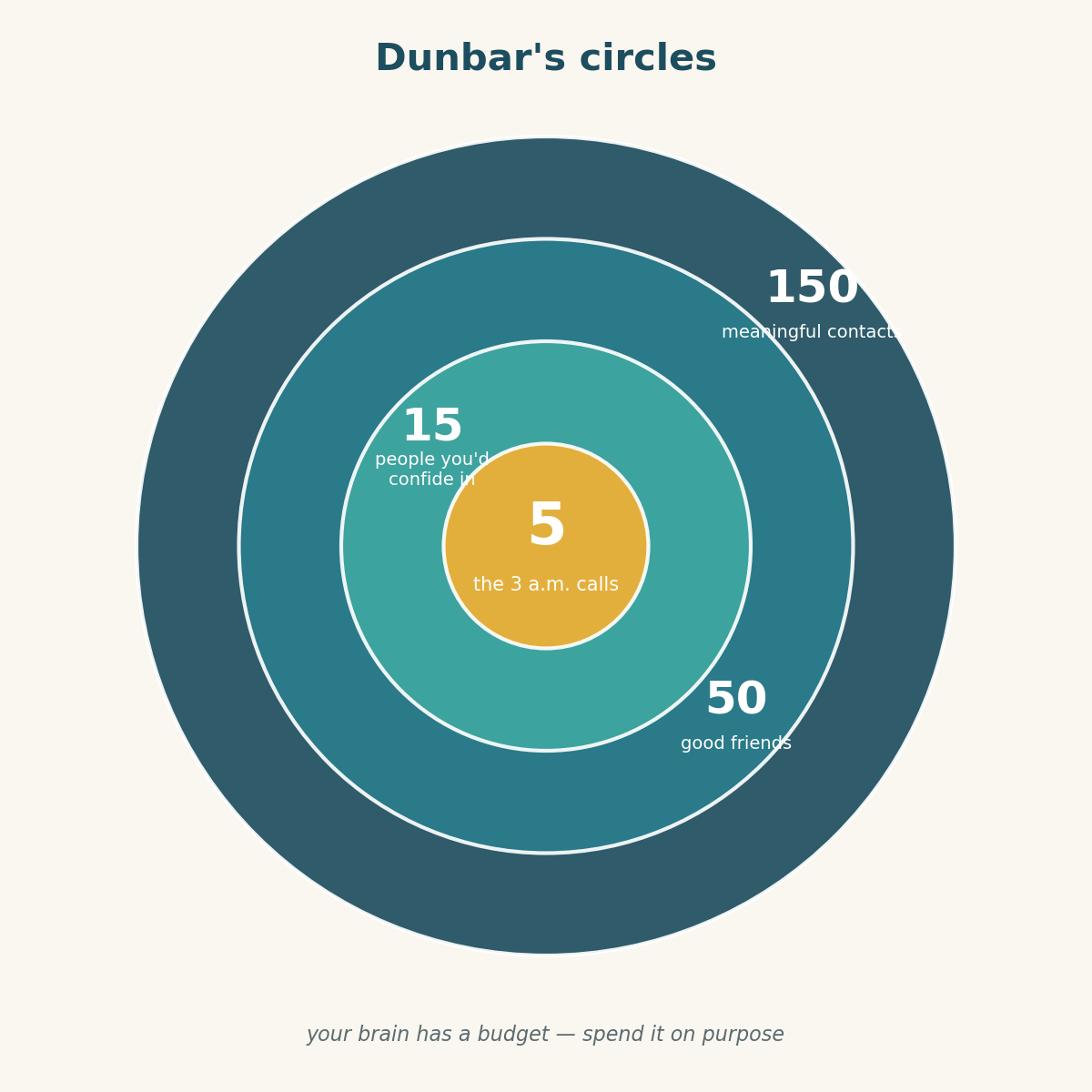
    The 150 is not one big group. It is circles inside circles, each about three times the last. Five people you would call at 3 a.m. Fifteen you would confide in. Fifty good friends. One hundred fifty meaningful contacts.

    Here is the part nobody quotes: each circle has a maintenance schedule. The five need contact about once a week. The fifteen, once a month. The 150, once a year. Miss the rhythm and the closeness fades within months. Friendships rarely end in a fight. They end in neglect.

    And here is where your attention actually goes: about 60 percent of your social energy flows to the innermost fifteen. Your happiness tracks those 5 to 15 people — not your follower count.

    So the question is not how many people you know. It is whether your inner fifteen are getting their share.

    Dunbar’s number is not a law — scientists argue about the exact figure. But the shape of it has held up for thirty years: your brain has a budget. Spend it on purpose.

  • 1 Is Alone. 1 and 1 Is 11, Not 2.

    1 is alone.

    1 and 1 is 11. Not 2.

    Find a partner — in business or in life — who is ten times better than you at something, and the combination is not addition. It is multiplication.

    I cannot be great at everything. Nobody can. Drucker put it plainly: it takes far more energy to drag a weakness up to mediocre than to take a strength to excellent. So I stopped trying to fix everything. Instead, I try to be great at one thing: knowing what needs greatness — and then finding the friends who have it.

    The numbers back this up. Two-founder startups beat solo founders by 163%. Diverse teams pull 45% of their revenue from new products, versus 26% for the rest. And Napoleon Hill wrote it down back in 1937: when two minds come together, they create “a third, invisible, intangible force — a third mind.”

    History keeps proving it. Wozniak built the machine; Jobs built the company. Walt dreamed; Roy paid for the dreams. Kahneman called his partnership with Tversky “a joint mind that was better than our separate minds.”

    But there is a condition, and Buffett named it: integrity, intelligence, energy — and without the first, “you want them dumb and lazy.” A brilliant partner you cannot trust does not make 11. He makes zero. Buffett and Munger never had an argument in almost sixty years. That is the glue.

    Let me be clear about one thing — this is not about depending on people. It is a trade. You have to bring something to the table too, because smart people will not partner with you unless you are the greatness they are missing. They cover your weakness; you cover theirs. Both sides give, both sides get. That is the only way 1 and 1 becomes 11.

    So here is my rule now. Know your strengths. Know your weaknesses even better. Find people who are strong where you are weak. And be loyal, honest, and trustworthy yourself.

    1 and 1 is 11. Choose your ones carefully.

  • MSTR analysis


    Key risks of buying MSTR

    1. Bitcoin price volatility
      • Since a large part of MSTR’s value comes from its bitcoin holdings, big swings in BTC price directly affect MSTR’s stock. If Bitcoin drops a lot, MSTR tends to drop more. (coininsight360.com)
      • Losses can be magnified because (a) MSTR uses debt and capital markets to fund BTC purchases, (b) there are accounting impairments when BTC’s fair value falls below carrying value. (Cryptodamus)
    2. High leverage and debt exposure
      • MSTR has taken on debt and convertible notes (debt that can convert into equity). If the price of stock or bitcoin falls, servicing debt becomes harder. (coininsight360.com)
      • Rising interest rates increase the cost of borrowing. If MSTR’s debt is floating or issues new debt in a high-rate environment, that raises risk. (Monexa AI)
    3. Dilution
      • To raise funds for buying more Bitcoin, MSTR has issued more shares and also preferred stock. More shares means each share holds a smaller piece of the pie. That can erode value for existing shareholders. (The Ridgway Record)
      • Convertible debts also could convert into shares, adding to dilution. (Investing.com)
    4. Premium collapse
      • The stock often trades at a premium compared to the NAV (net asset value) of its BTC holdings. If investor sentiment shifts or BTC declines, that premium can fall sharply, meaning MSTR could lose value even if BTC is steady. (BitcoinEthereumNews.com)
      • There’s risk that while BTC may go up, the stock doesn’t keep up or declines because the premium compresses. (Investing.com)
    5. Regulatory / tax / accounting risk
      • Laws or regulations around cryptocurrency could change. Tax treatment of gains or the way companies account for assets like Bitcoin might shift, increasing cost or risk. (Cryptodamus)
      • For example, under current accounting rules, when BTC value falls, impairment losses are recognized (even without a sale). This can hurt earnings reports and investor sentiment. (Cryptodamus)
      • There are recent/tending changes: e.g. ASU 2023-08 for reporting digital assets’ fair value, and potential exposure under the corporate alternative minimum tax (CAMT). (Investopedia)
    6. Liquidity risk / being forced to sell
      • If BTC collapses or if debt or preferred stock obligations are large, MSTR might need to sell BTC or raise capital at bad times, possibly locking in losses. (Cryptodamus)
      • If lenders demand repayment or in convertible debt scenarios, there might be pressure. (coininsight360.com)
    7. Operational / business risk outside Bitcoin
      • MSTR isn’t just a Bitcoin holding company; it has a software business. If that business underperforms (due to competition, product issues, or market conditions), it adds drag. (StockStory)
      • Reputation, cybersecurity, legal risks are also elevated given the size of its BTC holdings and visibility. E.g. risk of theft, regulatory scrutiny. (The Ridgway Record)
    8. Competition from alternatives
      • There are now “simpler” or more direct ways to get exposure to Bitcoin (ETFs, trusts). These alternatives might have lower costs, less complexity and less risk of dilution or accounting complications. Investors might prefer them, reducing demand for MSTR. (The Ridgway Record)
    9. Index / market structure risks
      • Because MSTR is included in various indices, its market-cap and the behavior of passive funds can amplify movements. If indices change rules or exclude MSTR, or if fund flows reverse, that could lead to rapid outflows. (Investing.com)

    Summary: Which risks are biggest

    • The biggest risk is probably Bitcoin going down — since much of MSTR’s value is really a leveraged bet on Bitcoin.
    • Leverage / debt magnify that risk.
    • Dilution (from share or preferred issuance) can quietly erode returns even if things look good at first.
    • Regulatory / tax changes could increase costs or reduce profitability in ways that are harder to predict.

    mNAV was 2.7 in May and its 1.42 now? Why is that?

    MicroStrategy’s mNAV (market-to-NAV multiple) was ~2.7 in May and is now ~1.42, meaning the premium that MSTR stock trades at relative to the value of its Bitcoin per share has fallen sharply.


    Here’s what drives the change:

    1. Definition of mNAV

    • NAV/share ≈ (BTC holdings × BTC price) ÷ shares outstanding.
    • mNAV = (MSTR share price ÷ NAV/share).
      So mNAV > 1 means MSTR trades at a premium to the value of its Bitcoin per share.

    2. Why mNAV falls

    A decline from 2.7 → 1.42 means investors are paying a much smaller premium now for each dollar of Bitcoin exposure via MSTR. The main reasons:

    1. ETF competition (structural factor)
      • In January 2024, U.S. spot Bitcoin ETFs launched. They let investors buy Bitcoin exposure directly, cheaply, and transparently.
      • Before ETFs, many investors used MSTR stock as a proxy for Bitcoin (especially institutions that couldn’t hold BTC directly). That demand inflated the mNAV multiple.
      • With ETFs available, demand for MSTR as a proxy declined, compressing its premium.
    2. Dilution from new equity issuance
      • MicroStrategy regularly issues new shares (ATM offerings, preferred stock) to raise capital to buy more Bitcoin.
      • More shares outstanding means NAV/share doesn’t rise as much as total holdings.
      • Investors may also price in dilution risk, lowering willingness to pay a big premium.
    3. Sentiment shift / less speculative enthusiasm
      • In periods of bullish hype, people are willing to pay large premiums for leverage via MSTR (since it acts like “Bitcoin on steroids” because of debt).
      • When sentiment normalizes or risk appetite drops, that premium collapses.
      • May 2024 coincided with strong momentum in Bitcoin expectations post-ETF approval → higher speculative premium. By now, sentiment is cooler.
    4. Market recognition of alternatives
      • Besides ETFs, investors realized they can simply buy BTC itself or funds with lower management cost and no corporate execution risk.
      • MSTR has software operations, debt service, dilution, and tax/accounting quirks. These risks weigh on valuation vs. pure BTC exposure.
    5. Index / market technicals
      • MSTR inclusion in indices can inflate price temporarily. If weighting changes or flows slow, demand eases.
      • That also pulls mNAV lower.

    3. Interpreting the drop

    • At 2.7 mNAV: You were paying $2.70 for each $1 of BTC that MSTR actually held per share.
    • At 1.42 mNAV: Now you pay $1.42 for each $1 of BTC held.
    • The drop means either:
      • MSTR stock rose less than BTC, or
      • BTC rose while MSTR stayed flat, or
      • MSTR issued shares that increased NAV/share but share price didn’t rise proportionally.
        In practice it’s a combination of these, mostly due to ETF competition and dilution.

    What about buying bitcoin ETFs vs MSTR, is or isn’t MSTR better leverage?

    Yes, this is a key consideration: MSTR vs a Bitcoin ETF is not just a straight BTC comparison, it’s really about leverage, risk, and structural differences. Let’s break it down clearly.


    1. MicroStrategy (MSTR) as leveraged BTC exposure

    Mechanics:

    • MSTR buys Bitcoin using both cash and debt, then holds it on its balance sheet.
    • Shareholders get exposure to Bitcoin plus any leverage effect, because debt amplifies gains and losses.
    • Example (simplified):
      • Company has $1B cash + $1B debt, buys $2B BTC.
      • If BTC rises 10%, NAV rises 10% on $2B holdings. But debt is fixed, so equity holders’ gain is magnified.

    Pros:

    • Leveraged upside without personally taking on margin risk.
    • Institutional infrastructure already in place (you don’t need to manage storage/security).
    • Could outperform BTC in a bull market because of leverage and premium multiple (mNAV > 1 at times).

    Cons / Risks:

    1. Leverage downside – losses are amplified if BTC drops.
    2. Dilution risk – new shares issuance to buy BTC lowers NAV/share.
    3. Debt / interest risk – company must service debt even if BTC falls.
    4. Premium risk (mNAV compression) – you may overpay relative to NAV.
    5. Corporate / operational risk – SEC filings, accounting, legal issues.

    2. Bitcoin ETFs

    Mechanics:

    • ETFs (like BITO, BTF) track BTC price, sometimes with futures contracts (for BITO) or spot BTC (for spot ETFs).
    • Price moves almost 1:1 with BTC, minus fees.
    • No company leverage is applied; you get pure BTC exposure.

    Pros:

    • Cleaner exposure to BTC price.
    • Lower fees than indirect corporate vehicle.
    • No dilution or operational risk.
    • No corporate debt or mNAV risk.

    Cons / Risks:

    • No leverage, so upside is “pure BTC,” not magnified.
    • Futures-based ETFs can have tracking error (for BITO).
    • Taxes may differ (depending on ETF structure).

    3. Comparing upside / leverage

    • MSTR is leveraged BTC, in the sense that gains/losses per share can exceed BTC’s % change.
    • But that leverage comes with extra risk (debt, dilution, corporate operations).
    • ETFs give you clean 1:1 exposure, but no magnified upside.

    Illustration (rough numbers):

    ScenarioBTC +10%BTC -10%
    BTC ETF+10%-10%
    MSTR (leveraged, mNAV > 1)+15–25%-15–25%

    The actual leverage depends on debt, premium, and share issuance timing. In practice, MSTR’s volatility is much higher than BTC, both up and down.


    4. Key consideration

    • If you want pure BTC exposure with less complexity, ETFs are better.
    • If you want leveraged upside and can handle volatility, MSTR can outperform in a bull market.
    • You must be ready for larger swings, dilution, and mNAV collapse, which can happen even if BTC goes up modestly.

  • Thoughts to ponder on …

    If you’re not a liberal at twenty you have no heart; if you’re not a conservative at forty you have no brain.

    Often attributed to Winston Churchill, but origins unknown

    When I was a boy of 14, my father was so ignorant I could hardly stand to have the old man around.
    But when I got to be 21, I was astonished at how much the old man had learned in seven years.

    Mark Twain

    I am not young enough to know everything.

    Oscar Wilde

    At twenty years of age the will reigns; at thirty, the wit; and at forty, the judgment.

    Ben Franklin

    “At fifteen, I had my mind bent on learning.
    At thirty, I stood firm.
    At forty, I had no more doubts.
    At fifty, I knew the will of Heaven.
    At sixty, I was already obedient to it.
    At seventy, I could follow my heart’s desire without overstepping the line.

    Confucious

    Youth is easily deceived because it is quick to hope.

    Aristotle

    The young are slaves to their desires; they are impulsive and easily misled.

    Plato

    “Wisdom is the daughter of experience.”
    Youth has energy; age has understanding.

    Leonardo da Vinci

    Old age, especially honorable old age, has so great authority, that this is of more value than all the pleasures of youth

    Cicero

    The first half of life is devoted to forming a healthy ego, the second half is going inward and letting go of it.

    Carl Jung. Jung framed life as two arcs: outward ambition, and inward integration.

    It is not that we have a short time to live, but that we waste much of it.

    Seneca (Letters to Luciluis) | A comment on how youth often squanders time, not recognizing its value.

    Young people are passionate, quick-tempered, and apt to follow their impulses. They are hopeful, because they have not yet been humbled by experience.

    Aristotle (Rhetoric)

    The unexamined life is not worth living.

    Socrates

    He who has a why to live for can bear almost any how.

    – Friedrich Nietzsch

  • I’m not afraid of an army of Lions led by a sheep; I’m afraid of an army of sheep led by a Lion

    Alexander the Great

    Historical Context

    • Alexander the Great (356–323 BCE) was the King of Macedonia who created one of the largest empires in ancient history by the age of 30.
    • He was known not only for his military conquests but also for inspiring fierce loyalty among his troops.
    • The quote emphasizes the impact of leadership over brute force or individual strength.

    In Alexander’s time, wars were often won not just by superior manpower or weaponry, but by strategy, morale, discipline, and leadership. His ability to lead — to turn ordinary men into a cohesive, fearsome force — is legendary.

    Interpretation

    The quote contrasts two scenarios:

    • Lions led by a sheep: Even powerful individuals can be rendered ineffective by weak, indecisive leadership.
    • Sheep led by a lion: Even ordinary, timid people can become formidable with bold, strategic leadership.

    In essence, leadership can elevate the collective potential of a group beyond the sum of its parts — or destroy it.

    Key Learnings

    1. Leadership is Multiplicative

    • A strong leader magnifies the effectiveness of a group, regardless of their initial capabilities.
    • Conversely, weak leadership undermines even the strongest teams.

    2. Courage and Vision Can Be Contagious

    • A lion (courageous leader) instills belief, discipline, and direction.
    • People may perform well above their natural ability if led by someone they trust and believe in.

    3. It’s Not Just About Talent

    • You don’t need the best people — you need the right mindset and the right leader.
    • In business, sports, and military contexts, success often hinges on leadership more than resources.

    4. Character Over Credentials

    • The lion symbolizes not just courage, but decisiveness, accountability, and vision.
    • True leadership is about taking charge, even when odds are against you.

    Applications Today

    • Teams & Startups: A startup with average talent but a bold, clear-headed founder often outperforms better-funded but poorly led competitors.
    • Organizations: Middle management can transform company culture — for better or worse — depending on their leadership capacity.
    • Politics & Movements: History is full of underdog groups that accomplished great change through powerful leadership.

    Closing Thought

    This quote isn’t just about military command. It’s a timeless truth: Who leads matters more than what they lead.

  • Southwest just made a financially rational but brand-risky move. Will it pay off?

    Southwest Airlines Now Charges for Bags — as of May 28

    Not sure if you caught the news — Southwest Airlines just announced it will start charging for checked bags, a significant departure from its long-standing “Bags Fly Free” policy.

    This isn’t just a pricing change — it’s a strategic shift that repositions the airline both in terms of revenue model and brand identity.

    Starting today (May 28, 2025), Southwest will charge:

    • $35 for the first checked bag
    • $45 for the second
    • Exemptions: A-List members, business fare travelers, and co-branded Southwest credit card holders.

    Pros of Charging Baggage Fees

    • Still Rewards Loyalty – Loyalty members and business class passengers retain free bags
    • Massive Revenue Opportunity – In 2024, Southwest made just $83M from checked bag fees, despite carrying 2–3x more checked bags than peers. Competitors typically make in the range of $1.5 – $1.8B in baggage fees. But, Southwest made up for that By matching competitors and assuming they keep their baggage volume (which they likely wont), Southwest could unlock $1.2B–$2.5B/year in new gross revenue.
    • Investor Confidence
      Investors want to see margin growth. This is a low-effort lever to expand EBITDA without cutting services.
    • Competitive Parity
      United, Delta, and American already charge $35–$40. Southwest no longer stands out as “missing” revenue. They’re no longer leaving money on the table.

    Cons of Charging Baggage Fees

    1. Erosion of a Core Brand Promise
      “Bags Fly Free” has been Southwest’s differentiator for decades — it’s even trademarked. Removing it risks breaking customer trust and diluting brand equity.
    2. Volume Loss Will Undercut Revenue
      Their high bag volume wasn’t because people love checking bags — it was because it was free. Introducing fees will reduce checked baggage volume (likely by 40% or even more), minimizing the revenue upside.
    3. Customer Experience Will Suffer
      Expect longer boarding times, more crowded overhead bins, and frustrated travelers who now try to avoid fees.
    4. Commoditization Risk
      Southwests full priced tickets are more expensive than others. Their attraction was to those who can plan ahead and tap into the ‘wanna get away’ prices for their tickets. Anyone else who wanted free bags would end up paying more (but still lesser than ticket + bags for the others). With Southwests new move, their price, schedule, and product all start to look the same as other airlines and in some cases Southwest comes out being worse (the other airlines Delta, American in particular have nicer/newer planes). Brand distinction erodes, and price sensitivity increases.

    What the data says?

    • Southwest’s passenger base includes a high share of families and value travelers, who are very fee-sensitive
    • JetBlue, after introducing bag fees, saw a 15–25% drop in checked baggage volume
    • Delta and United generate $1.4B–$1.7B annually from baggage fees — despite lower bag volumes than Southwest.

    What the market looked like in 2024?

    • Southwest Airlines holds a 17.3% share of the U.S. domestic market, closely trailing Delta Air Lines (17.8%) and American Airlines (17.5%).
    • The combined market share of the top four carriers amounts to approximately 68.6%, underscoring the industry’s concentration.
    • Alaska Airlines, Spirit Airlines, JetBlue Airways, and Frontier Airlines collectively contribute an additional 19.2% to the market, while the remaining carriers account for 12.2%.

    This data highlights the competitive landscape of the U.S. domestic airline industry, with the “Big Four” dominating the majority of the market.

    RankAirlineMarket Share (%)Revenue Passenger Miles (RPM)
    1Delta Air Lines17.8%142 billion
    2American Airlines17.5%139 billion
    3Southwest Airlines17.3%138 billion
    4United Airlines16.0%127 billion
    5Alaska Airlines6.1%49 billion
    6Spirit Airlines4.9%39 billion
    7JetBlue Airways4.7%37 billion
    8Frontier Airlines3.5%28 billion
    9SkyWest Airlines2.4%19 billion
    10Hawaiian Airlines1.7%14 billion
    —Other Carriers8.1%64 billion

    What were their revenues?

    AirlineTotal Revenue (USD)Source
    Delta Air Lines$61.6 billionDelta Air Lines 2024 Financial Results
    United Airlines$57.1 billionUnited Airlines Holdings Inc Revenue 2010-2025
    American Airlines$54.2 billionAmerican Airlines reports fourth-quarter and full-year 2024 financial results
    Southwest Airlines$23.0 billionSouthwest Airlines Lifts Revenue Outlook on Resilient Travel Demand

    Delta Air Lines led the industry with the highest total revenue in 2024, followed closely by United Airlines and American Airlines. Southwest Airlines recorded significantly lower total revenue compared to its counterparts, reflecting its low-cost carrier model and focus on domestic routes. So, in doing what they are doing and have done so far, Southwest is makign a move away from being a Low-cost carrier (LCC) to being a full service carrier. This broad redefinition of the company comes with huge risks. Differentiation is a hard thing to build (more on this soon) and it seems someone at Southwest is taking that “asset” lightly.

    In summary, does this move pay off?

    In the short term — yes.
    Long term — its super risky.
    They are trading away a legendary differentiator, and they are taking a huge risk by trading it for parity pricing. They will gain in ancillary revenue but could lose big time on brand differentiation and that can lead to revenue leaks that are much larger than the potential gain. The answer to “Why choose Southwest? was much easier earlier, but not anymore. Looks like “the skies are getting less friendly”

  • Managing Up Is Not Sucking Up

    Managing up is a skill. Sucking up simply sucks.

    Sucking up is flattery for personal gain. Managing up is partnering with confidence to drive collective success.

    People who manage up aren’t spineless yes-men—they have a backbone, stand up for their ideas, and align their efforts with their manager’s goals and the organization’s vision. They’re strategic, authentic contributors who help the company grow while growing themselves. Here’s what sets them apart:

    Traits of People Who Manage Up Effectively

    1. Clarity of Purpose: They understand their manager’s priorities and the company’s direction—like driving B2B growth—and focus their work to support those goals.
    2. Courageous Communication: They speak up with conviction, sharing ideas or concerns respectfully, even when it’s tough, to advance the team’s mission.
    3. Proactive Problem-Solving: They anticipate challenges, propose solutions, and take initiative, not waiting for permission to add value.
    4. Authentic Alignment: They connect their work to the organization’s vision with integrity, not by pandering but by showing how their contributions fit the bigger picture.
    5. Confident Collaboration: They partner with their manager as equals, offering support while advocating for what’s right for the team and company.

    Sucking up stalls you—it’s empty praise with no substance. Managing up moves you forward. When you align your work with the company’s goals, like growing market share, you deliver real impact. That’s how you gain skills, trust, and opportunities. That’s how we win together.

    Be a confident partner, not a flatterer. Show these traits in your work, and you’ll help shape the organizations future while building your own. What’s one way you’ve managed up with backbone? Share below or let’s discuss!