We’ve known this adage since our early days. Yet most of us think that the formula to success is a lot, and I mean a lot of hard work. Hard work alone will make you dreary, tired and mostly unproductive.
Instead, Focus on balancing your day. Do everything in the right proportion. Right has a different meaning from day to day.
In his Autobiography, Benjamin Franklin revealed his daily schedule for peak productivity. Key thing to notice is – the schedule is kept simple. Work has a place in the schedule but so does sleep and R&R.
Our teams and clients have been using TimeChili to audit our schedules and achieve not just productivity but also high engagement and wellness as a result of the process.
On a lighter note, heres what we all need to be doing…
Try auditing your time. Your gonna love it!
PS: Busyness leads to bad decisions. Try not to be busy. Try doing more with less. We can escape the tunnel of busyness by “thinking about our schedules as less like a pantry that we cram anything…into, and more like an art gallery where we…decide what is most important and how to arrange it so that everything fits.”
We live in a world that rewards busyness and the idea of ‘getting things done’: an addictive rat race to cross off as many things from your to-do list, as fast as possible.
Because of this viral hype, we bury ourselves in busyness and attempt to achieve much more than we’re capable of.
Productivity isn’t about getting more things done, rather it’s about getting the right things done, while doing less.
The best way to figure out the right things to focus on and the best ways to tackle them, is to spend more time alone with your thoughts and embrace solitude.
Read more https://www.mayooshin.com/einstein-productivity-tip/
Gratitude is the best part of a great attitude. I say always be shooting for what you want and be grateful for that you have (irrespective of what the year looks like)
Every organization wants to be a high performance organization. But not everyone gets there.
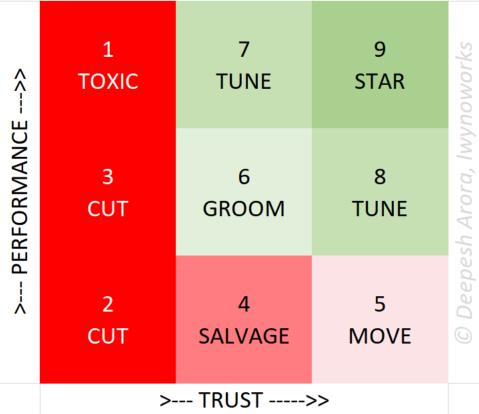
When shaping your organization, use this grid to evaluate your greatest asset – your people. Its just one of the ways to shape & fine-tune your organizations potential
High performance people who exhibit a high trust quotient can be pillars to your organization. They need to be contributing where it matters most to your organization.
Its a grid I have used internally and am now sharing with you. Not from a management book but from real life experience creating and grooming high performance teams. A key aspect of organizational development, is to build & groom a strong team of leaders who are better than you at the things they do.
Its common to think “High performing organizations are made up of high performance people”
But this isn’t can’t really be true. Some very large organizations are high performance organizations. Doesn’t mean that they are full of high performance people. And not everyone who is a high performer is at the peak of their performance all the time. So what is it that separates a high performing organization from one that does not.
You may say its about culture. But culture means so many things to so many people. Culture comes from behavior. You cannot install a culture but surely you can cultivate one. Culture can be built. So how does one build it?
There are many many subtle and not so subtle aspects to building a high performing organization. A key one that comes to mind is trust. High performing organizations are built on high levels of trust. So do people in high performing have very high levels of personal ethical standards. Again, hard to generalize and fit all individuals into the same mold. The reason organizations perform better than individuals because the collective is stronger than the individual due to their diverse strengths. These individuals are different in so many ways but so very similar they action in some few ways.
So how do you build Trust in an organization?
For people to trust each other, they need a basis on which their minds can agree that I can depend on this other persons words, actions or promises. The aspect of uncertainty the exists in a given word needs to eliminated by specific proof points that turn that uncertain outcome into a highly likely to be certain outcome.
Trust is an attribute of the relationship between people. A situation of high trust is one where one party is willing to rely on the actions of the other party.
To establish a baseline trust, individuals need to know that the other person can be trusted.
Imagine you and I enter a transaction where I am supposed to deliver certain goods to you in exchange for an order. How are you to trust me that I will deliver the order? How am I to trust you that I will get paid, after I deliver the order?
In this case, each of us trust ourselves to do our part, but we do not have a basis to ‘establish trust in the others actions’. This comes from Transparency.
Transparency is a way to reveal your true self. You put yourself in an open and vulnerable position to help the other feel confident & comfortable with your promises or actions.
Learning to be transparent is a not easy. It is often a nervous situation for someone who is not used to being transparent. But the benefits are plenty.
Take our example above, now if I tell you publicly (in a forum where it matters, where I can be held accountable) that I will deliver the goods if you put in an order, then I have put my “skin in the game”. You are now comfortable in trusting me. If you were to do the same thing, by giving me the order and saying you would pay me when I deliver, then you have reciprocated with a similar level of transparency and given me a reason to trust you.
Working with each other in such transparency model leads to each of us building a reputation for ourselves and a environment of trust between each other. Once trust is in place, we will do greater things together and eventually find ourselves in a zone of high performance.
I started out with the thought of getting more out of my time. Ever since this pandemic has started, we are all working from home.
While there are a lot of pros in working from home, it can tend to get to you sometimes. Work time has little boundaries and it tends to spread into your day. You find yourself working all the time. This is why defining your time boundaries and planning your time becomes very important.
I set out on a mission to measure where I spend my time so I can get more done in less time. A secondary goal with measuring time was to also find out where I may be spending that I should not be. Being in the business of technology, I began evaluating tools in the time tracking arena.
Most tools in the time tracking realm seem to attack the problem in the same way. They all give you some sort of web or desktop widget that can enables to you essentially fill out a timesheet. This all seemed very counter-productive to me and within a few attempts I found the task to be cumbersome and non intuitive to how I work. In a few days the entire idea of tracking time was lost and this really wasn’t working out.
The problem can be better solved if I can install a widget that quietly watches what applications I use, what websites I visit and at the end of the day automatically generates a timesheet for me to review and get a clear picture of where I spent my time. I know, I know this opens up the issue with trust. What if the company making such a tool is now taking my data and turns me into the product. Easily solved if I can build it myself and protect my privacy.
I can imagine a million use-cases for such a product – and it can be helpful to a lot of people I know
I can measure my productivity and know how much time I spent actually working in a day vs being on the phone, conference calls etc
What time was spent by my technology teams in direct coding product, researching online or in discussions with others
Accountants can know which time when towards which clients work or project and they can bill even more accurately.
Lawyers could do the same with their hours and not spend time in tracking their time
Freelancers could benefit not only in tracking time but using this information to also gain insights in where their estimates were off and how they could be giving better estimates for projects. They could even be using this information to justify & rationalize their estimates.
Technology companies could do the same – give each member of their company access to this tool so each can measure their time (maintain their privacy) and then report the time they spent on which project. I can already see myself giving this to my team so we can know where we as an organization are spending our time. Seems like an innovative way to be building in measurement with the goal of self-improvement.
All startups are young upstarts. But not all young upstarts are startups. So think through a few points before you call your new business a startup.
In all my time working with startups in various capacities including as a founder, an advisor, a consultant or a mentor to founders I start with asking the following questions to understand if the business entity is really what I call a startup?
Are you chasing a Big Hairy Audacious goal?
How are you going to change the world (of whatever your industry is)? (lets talk disrupting or challenging the status quo)
What does your team look like. Are they well positioned to attack such a problem?
What is your end-game? Do you have an end-game?
How resource constrained are you?
How agile & innovative are you?
As a general rule, start-ups need to have a clear target and it is generally good for it to be a huge target (in size and in difficulty level). You should be doing something ‘really different’ – solving a new problem or solving an existing problem in a a much more efficient way (larger, better.
The riskier your proposition, the lower the chance of someone succeeding at. The riskier the problem, more credible should be the people you need in solving it as that will increase your odds at it.
For every project or initiative you take on, its wise for you have an end-game? Have a clearly defined direction and be nimble enough to make as many left and right turns to get to your finish line? Remember, you are resource constrained, have a big goal to hit, have limited time & money and hence you need to be smart in everything you do. Your team and your approach is your core differentiation. In venture capital parlance, “its all in the team”.
Once you have established that you have a decent understanding of the problem and can build some comfort in your audience that there is some chance of you solving this problem then you can start talking of raising funds. A startup generally needs outside funds for their high-risk high-rewards venture. This is where angels or VCs come into the conversation. See my note So you just ‘raised funds’. Good! But the journey has only begun
If you can answer yes to more of the points above, I think your business is deserving to be called a startup.
Startup ventures receive a lot of attention. It indeed is glamorous to be running a startup. Or at least it appears so from the outside. Startups are a LOT OF WORK. It takes a lot of perseverance, patience and persistence to take an idea, create a startup and then build a business out of it. You will learn 10x more at a startup than someplace more relaxed and cushy.
Raising funds is great news for a startup. But, its just one of the many milestones along the way to your metaphorical destination (the goal). If this was a road trip, initial funding is analogous to filling up your tank (mostly on borrowed money) so you can reach the next fueling station.
You are in uncharted territory, you think you have a general direction and there is no defined map to your destination whatsoever. No ones been there before, your path isn’t paved & there are no road signs along the win.
Picture navigating through a vast desert with limited water. It can be done if you either get lucky (some do, most don’t) or if you move economically, get the most mileage out of your fuel, make mindful decisions (almost all the time) when making left or right turns or not and have a method to your madness.
Focus and calm will get you there, just stay prepared to outlast whats thrown at you. Things will go wrong, just make sure you know to correct them and do it all before time runs out!
I hope you see why, its just the start. So… Congratulations, you just got funded! One of ‘n’ variables, under control 🙂
Remote work or working from home are commonly used terms in the vocabulary of a knowledge worker.
Work-Life balance is another term that is often discussed at length. I personally do not agree with the term and how it sounds. I prefer to use ‘life balance’. Work as an activity does not conflict with life, like other activities work happens as you live through the game of life. Life is what you live. Work is one of the things you do as part of life. They go together and are not in conflict with each other.
Working from an office and working remotely each have unique advantages to offer. I love what I do, so for me work brings joy. My family is very important to me. And they do not compete with my work for my time – no ones family should. Work, Family, personal time, hobbies etc are all activities we must do. Its part of our karma. Each of these activities fulfill an important goal (like paying the bills) and all these activities in your life are to be done harmoniously.
Striking the balance
If there is a form of imbalance of activities in one’s life, only you can define what looks like the ‘right balance’ and you must introspect to answer that question. There are many forms of work which can help me pay my bills, maybe the one form that you are engaged in is not in harmony with your life goals. In such a case, pick another path (form of work) that is aligned with your life goals. That’s one way to seeking ‘life balance’
choosing responsibly
The idea of working responsibly is not very well understood by most and once an individual or a group of individuals understand ‘working responsibly’ – the work-life balance discussion gets muted quickly.
Working at the office – critical to meet people, get to know them better, build relationships
Working from home – flexibility of time & space, fewer distractions, higher focus & concentration, get more done, higher availability to family
In my view, depending on who you are and your goals, the balance comes from making the right choices. Working from home does not spoil one’s life balance, instead it can enhance it. It brings the individual more control (remember, its a privilege) to bring your life in better balance. For me working from home means I’m committed to my goals & deadlines while exercising the privilege build flexibility into my schedule. In short, I do what I need to get things done.
When it comes to my time, Its my responsibility to define the boundaries on where and how I spend it. When I make a choice, the accountability of the choice resides with me. With all kinds of ‘power’ there comes responsibility.
Remote work is a gift for both employees and employers. If it involves people, good communication is the key to success. We need to have a clear agreed upon goal. And use the privilege responsibly.
I have found the following to work –
Be transparent. Look ahead, avoid surprises. Be clear on goals.
Set expectations. Define boundaries.
Communicate. Remember to be transparent
These days, we are working from home and its our only option due to the ongoing pandemic. And while it isn’t a choice, we can all still choose how we will make the most out of ‘working remotely’ and experience all the benefits of working from home first hand.
A touch more of communication + a little bit of transparency = Opens up a lot more flexibility in getting work done
If it matters to you, do not postpone it. Most humans get caught in the conundrum of life.
If I had this, I would do that…
I’ve I achieve X, I will do Y…
Most dreams we postpone should not be pushed forward. Have to live each day as if it’s your last. Times running out. Today is better than ever. Do it now before it becomes never.
It may be good to sacrifice sometimes but be careful about what you choose to give up. For most things you will find “now is as good a time as any”. For something you will never be better prepared, the test in itself is the preparation.
There’s never a better time to get married, have a child, invest time in a relationship, learn something new, pursue your dream or for reaching out to a loved one. Now is always the best time. You can never be more prepared than you are today, no matter who you are and at what stage in life.
Some things cannot be deferred. When you are young, you have great energy, awesome health but you may not have the money or the time for those things.
When you’ve turned a little gray, you aren’t exactly young anymore. You may have some savings but you don’t seem to have the time. Maybe it’s your busy schedule, you now have a family or other ambitions or responsibilities. You could once again defer “your thing” to someday.
Time progresses. It doesn’t wait. You’re going to keep aging. You may be getting wealthier but it’s hard to get heathier. Time is what you make of it. Because times not going to wait for it.
Decide who you are and what you want to do. Do it now. Because now is better than ever. Time teaches. Time heals. Pursue that dream, don’t need to prepare for it. Learn as you go and get there as you grow.
Applies to businesses as much as it applies to people.
“Try not to be everything to everyone For you risk being nothing to anyone Its best if you can be something to someone”
-Yours truly, DA
Those words remind us of a simple but true principle. You can’t please everyone, so why try? Be yourself, know yourself. For a business to succeed, it needs to appeal to customers. You begin with segmenting your target customers / market. And then figure how you make your products/services attractive to those customers. Run after every kind of customer and you end up appealing to no one. Pick your target, nail it!
Define who you are and know that you cannot be liked/loved/admired by everyone. So do not try to be everything to everyone.
Grab a glass of win, think about this and how it applies to you applies to you, family, friends and life in general.
Define yourself. Know who you are. Have an identity. Know your personality. Live it. Figure who you are, who you can appeal to and focus on being the best version of you to them. You’re an original, do not try to copy anyone else. Be yourself.
In short, make a choice and live it the best you can.
Since the time this pandemic has started, there are so many things that are not the same…There’s quite a bit of talk about what is or has or will change for ever.
And there is so much that isn’t really going to change. Yet, there is little discussion about what will not be changing. The future depends not on what is going to go away but on what this new way of life is going to be.
My observations on what’s changed, likely changing, will remain the same or is a new realization for us:
[ It’s a given ] We’re wearing masks and washing our hands more than ever. We fear an unknown enemy – the virus.
[ New realization ] Office spaces are likely to shrink …not everyone needs to come in to work every day. Some people can work from home on all days.
[ New realization ] Smart companies can think of hiring many more remote workers than we do today.
[ New realization ] A lot can be done online… many activities have shifted online.
[ New realization ] I’ve seen way more people walking, running, breathing fresh air than ever before.
[ New realization ] Family time is amazing time. This was a somewhat ignored part of most peoples’ pre-pandemic lives.
[ New realization ] Cooking at home is not that hard. More of us have discovered our inner cook. Given the choices, we may not eat out as often as before. Doesn’t mean there is anything wrong with pampering yourself and eating out (thats going to continue)
[New realization ] This thought has passed most knowledge worker’s minds. “If I can work from home, why do I need to live in a big city?” Smaller towns & cities could be seeing an in flow of new or returning residents. Larger towns could get some breathing space. Rents, property prices could be affected in both places.
[New realization ] Friends and family play a much larger role in our existence. Maybe we need to be giving those relationships more attention. Lets not take things for granted.
[Likely change] Contactless / touchless business transactions should be seeing an increase. Think delivery, transportation, hospitality…
[This continues] Humans are social animals….nothings changed on that front.
We are going to travel.
We are going to eat out (how we do it may shift but the activity will persist)
We are going to learn to do things.
[This continues] For a good life, we must focus on our health. We must workout to stay healthy. Many have realized the importance of being / staying healthy.
[Likely change] If I’m going to work less often and working out more often. How does my wardrobe change?
[Likely change] Will I be saving more of my money? For that rainy day…
What else do you see? Looking forward to your thoughts
Racism is not natural or innate – It is learned. So it can definitely be overcome with some effort on the individuals part.
Are you aware of the terms – sympathy, apathy, antipathy? These come naturally to humans
In general, we humans place ourselves first. Our innate immune response of self-protection seems to be on the frontline of all behavior. #self-before-all if you will.
This also implies that we humans have a general apathy towards ‘others’. We will define and redefine others as we move along. #dont-care-for-the-others-zone
Next we are sympathetic to those who you identify with. If we can find a sense of belonging with a person or group of individuals, we tend to sympathize with them. #our-sympathy-zone
By nature, we’re not born with any seeds of antipathy. Those seeds are sown by those around us. A child is born to love every color and not differentiate in any manner. Racism is learnt behavior. Its a form of prejudice that an individual harbors as a result of broad, baseless, untested, blindly accepted generalizations.
If you feel any form of prejudice towards any person or group, first introspect for your lack of awareness, your insecurities and feels of inadequacy.
An visual exercise , see your self sitting next to a candle in a huge dark room. Corners of the room further away from you are incompletely or not lit at all. You know what you see and you steer of the darkness cause you do not know what is there. You are afraid of venturing into that space as you ‘do not know’. That feeling of not knowing triggers your flight response – you are mistrustful of what you do not know.
Now if there are more people like you in that same space, you find them in your ‘sympathy zone’. Herd mentality kicks in, you think and believe what they might. You are far more prone to embracing prejudice. Now its very likely for you to behave in ways that ‘you’ as an individual would not have before.
Think about this? Is this why racism exists in many parts of the world? It seems we need to be more aware and together we can eliminate this nasty behavior.
Whenever the economy is discussed, the “consumer” invariably comes up. The consumers drive the economy.
They buy goods and services. Consumption is the largest component of any economies GDP. Individual buying acts are aggregated over whtime and space.
Any good business is created with the consumer in mind. As a business you sell what you ‘perceive’ consumers need or will buy.
Consumer patterns tend to shift, sometimes fast, sometimes slow. Existing businesses shift to align with these changes. New businesses (aka startups) emerge to capture these emerging trends.
It is imperative that every business invest its energy in studying their consumer. And where possible talk to their consumers and understanding the consumer needs.
Your business is as large as the number of consumers that you can attract and get them to pay for your product or service.
Not a stage, and not an audience I perform for. Just a place where I get to think openly, in public. My observations, my musings, what I think about what I see. If you want to read, read. If you feel like discussing it with me, I am here.
I will be wrong sometimes. That is part of the deal. The goal is to learn by doing it. Thinking is a skill, and skills get better with reps.
I am not in a race with anyone. This blog is called be.x2m.in — be times 2 minimum. Every time I look back and check, I want to be twice as good as the last time I looked.
So this is the record of that. Short posts, honest ones. What I am building, what broke, what I learned. Nothing here is a brochure.